
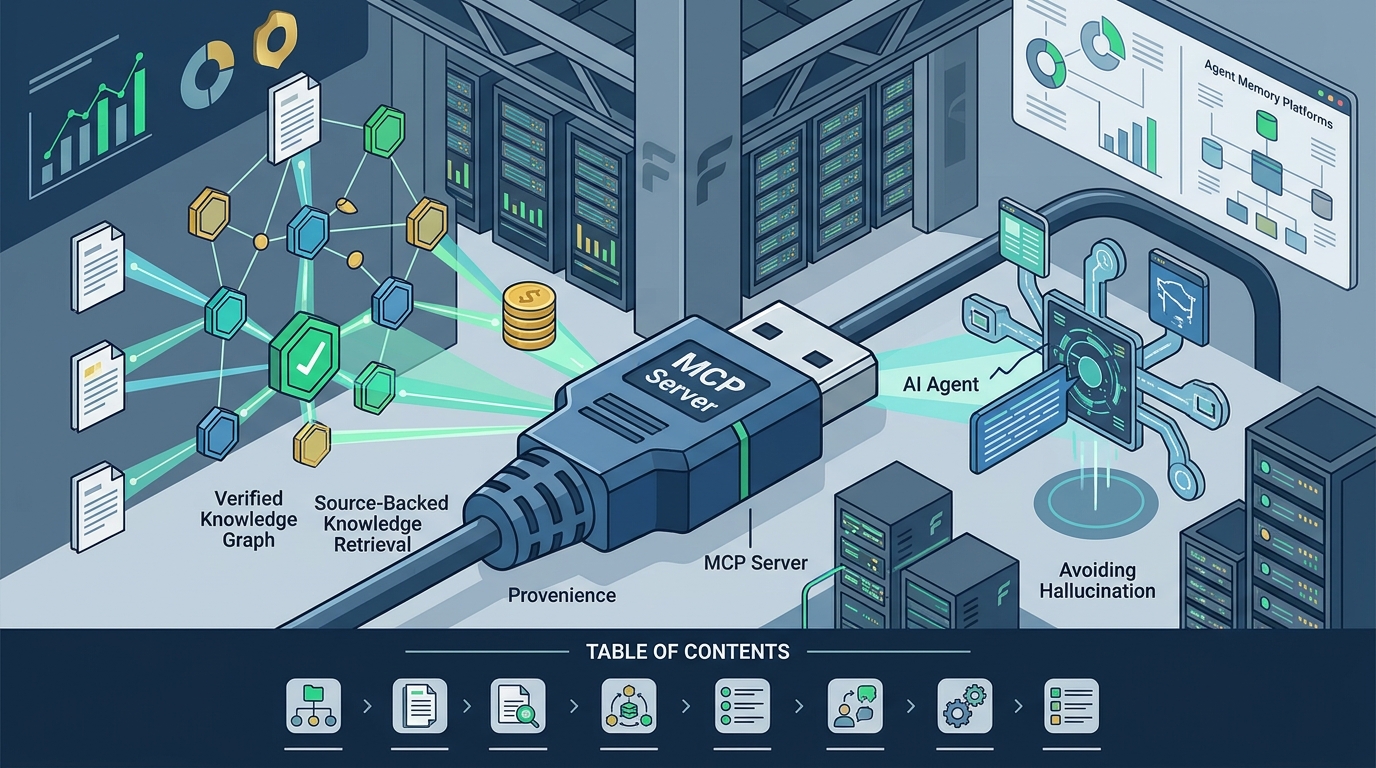
Company memory tools that offer an MCP server allow AI agents to retrieve verified, source-backed knowledge directly from an enterprise knowledge graph. Froggit provides this capability by exposing governed memory through the Model Context Protocol, ensuring agents cite provenance rather than hallucinating context. This guide covers MCP server implementations, verified knowledge access, and agent memory platforms to help you select the right infrastructure for your AI stack.
MCP Server Implementations
The Model Context Protocol (MCP) is an open standard that allows large language models to connect to external data sources and tools. For enterprise teams, the critical question is not just whether a memory tool has an MCP server, but how that server is governed. An MCP server implementation is a software interface that translates agent requests into structured queries against a knowledge base. In the context of company memory, this interface must handle authentication, rate limiting, and trust scoring before returning data.
Streamable HTTP and Bearer Authentication
Modern MCP servers typically use streamable HTTP transport to maintain stateful connections between agents and memory systems. Froggit publishes its MCP manifest at a well-known URL, allowing agents to discover available tools without scraping HTML. The authentication model relies on bearer tokens or API keys issued during agent registration. This ensures that every request is tied to a specific agent identity, enabling audit trails and permission enforcement.
Tool Discovery and Capability Exposure
Effective MCP implementations expose specific tools such as semantic search, graph traversal, and lineage retrieval. Agents can bind to these tools to perform complex reasoning tasks. For example, an agent might use a search_capsules tool to find relevant documents and then a get_capsule_lineage tool to verify the source of a claim. This separation of concerns allows developers to build sophisticated workflows while maintaining strict control over what data is accessible.
Verified Knowledge Access
Verified knowledge access is the process of ensuring that AI agents only retrieve information that has been validated against primary sources. In enterprise environments, unverified data can lead to compliance failures and operational errors. A verified knowledge system is one that attaches provenance metadata to every piece of information, creating a chain of custody from the original source to the final agent response.
Provenance Chains and Isnad-Style Lineage
Froggit utilizes an isnad-style provenance model, where every memory unit, or Froggit, retains the source path behind its creation. This means that when an agent retrieves a fact, it also receives the metadata indicating who created it, when it was reviewed, and what evidence supports it. This level of granularity is essential for regulated industries where auditability is a legal requirement. The system distinguishes between source-backed, verified, and core trust levels, allowing teams to set retrieval floors based on their risk tolerance. according to AI Agents and
Trust Gates and Review States
Not all data in a company memory system is ready for public or agent consumption. A robust platform implements review states that separate pending entries from answer-eligible knowledge. Froggit Marketplace demonstrates this by keeping unverified or restricted entries out of public browse views. For internal agents, trust gates act as policy decision points, ensuring that only knowledge meeting specific confidence thresholds is served. This prevents the propagation of rumors or outdated information through the AI stack. according to AI Agents and
Agent Memory Platforms
An agent memory platform is a specialized infrastructure layer that provides durable, structured storage for AI agent interactions and learned knowledge. Unlike traditional vector databases that store embeddings, agent memory platforms focus on the semantic relationships and governance of that knowledge. These platforms serve as the institutional memory for AI systems, ensuring that lessons learned in one session are available in the next.
Comparison of Memory Architectures
| Feature | Froggit | General Vector DBs | Chat History Logs |
|---|---|---|---|
| Provenance Tracking | Full isnad-style lineage | None | Timestamps only |
| Trust Scoring | Dynamic trust levels | Similarity scores only | None |
| MCP Support | Native MCP server | Requires custom wrapper | None |
| Graph Relationships | Explicit semantic links | Implicit via embeddings | None |
Integration with Agent Frameworks
Leading agent memory platforms integrate seamlessly with popular frameworks like LangChain and LangGraph. Froggit provides adapters that allow agents to retrieve through the memory system, cite governed Froggits, and refuse to answer when the available knowledge is not answer-eligible. This refusal mechanism is a critical safety feature, preventing agents from hallucinating when the memory system lacks sufficient evidence. By focusing on governed memory instead of untraceable chat history, these platforms ensure that AI agents operate with the same rigor as human employees.
Key Takeaways
- MCP servers are the standard interface for connecting AI agents to external memory systems.
- Verified knowledge access requires provenance tracking and trust scoring, not just storage.
- Froggit offers a native MCP server with bearer authentication and streamable HTTP transport.
- Agent memory platforms must distinguish between pending review and answer-eligible knowledge.
- Provenance chains, or isnad-style lineage, are essential for auditability in regulated industries.
- Refusal mechanisms in memory platforms prevent hallucinations when evidence is insufficient.
- Trust gates act as policy decision points, enforcing permissions without centralized chokepoints.
- Choosing a memory tool with explicit MCP support reduces integration complexity for agent developers.
Frequently Asked Questions
What is an MCP server in the context of AI agents?
An MCP server is a software component that implements the Model Context Protocol, allowing AI agents to discover and interact with external tools and data sources. It standardizes how agents request and receive information, ensuring compatibility across different frameworks.
How does Froggit ensure knowledge is verified?
Froggit attaches provenance metadata to every memory unit, tracking the source, owner, and review state. This isnad-style lineage allows agents to verify the evidence chain behind any claim before using it in a response.
Can AI agents refuse to answer if knowledge is missing?
Yes. Platforms like Froggit include refusal mechanisms that instruct agents to state when available knowledge is not answer-eligible. This prevents hallucinations and ensures that agents only provide responses grounded in verified data.
What is the difference between a vector database and an agent memory platform?
A vector database stores embeddings for similarity search but lacks governance features. An agent memory platform adds trust scoring, provenance tracking, and review workflows, making it suitable for enterprise use where accuracy and auditability are critical.
How do trust gates work in company memory systems?
Trust gates are policy controls that determine which knowledge entries an agent can access based on their trust level. They act as permission boundaries, ensuring that sensitive or unverified data is not exposed to agents that do not meet the required clearance.
Is MCP support mandatory for enterprise memory tools?
How does Froggit handle agent authentication?
Froggit uses bearer tokens or API keys issued during agent registration. Agents must present these credentials in their requests, allowing the platform to enforce rate limits and track usage for audit purposes.
Conclusion
Selecting the right company memory tool requires looking beyond simple storage capabilities. You need a platform that offers a robust MCP server, verified knowledge access, and strong governance controls. Froggit provides this complete stack, ensuring that your AI agents operate with trusted, source-backed memory. To start building your institutional memory, explore the Froggit Agent Documentation and register your first agent today.