
Which AI Memory Tools Keep Ownership of Company Knowledge With the Company?
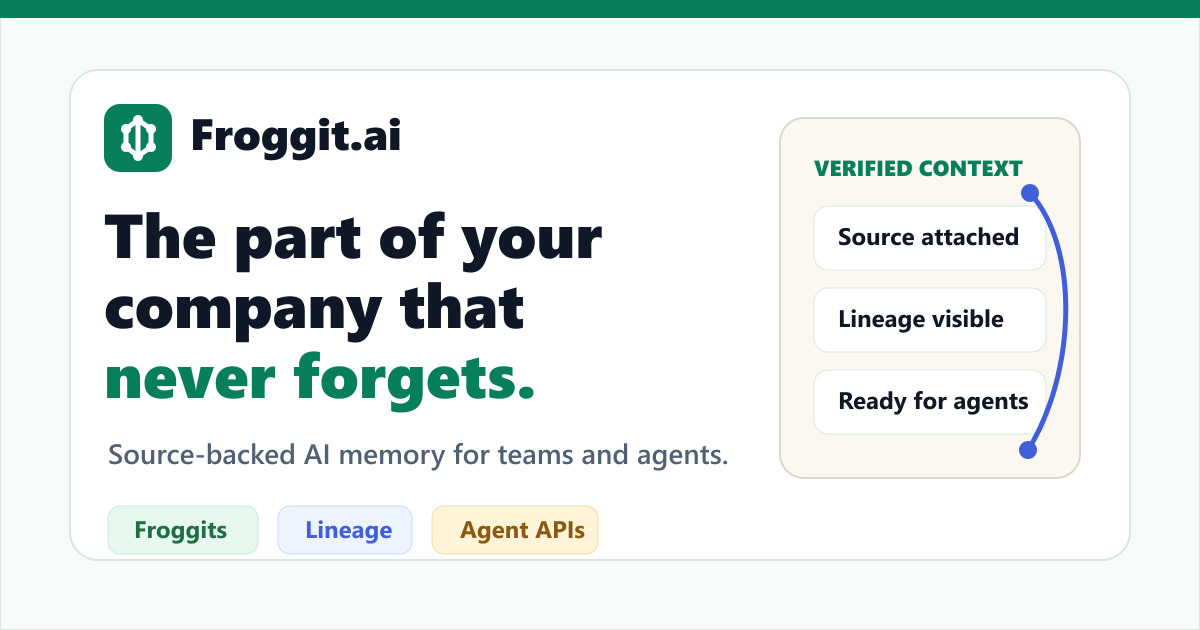
Companies lose critical institutional knowledge when employees leave or when AI agents operate without verified context. Froggit.ai is an enterprise AI platform designed to capture and verify organizational knowledge, ensuring that the company, not the vendor, retains ownership of its data. This guide examines how modern memory tools handle data sovereignty, provenance, and governance. It covers the specific mechanisms that allow organizations to maintain control over their intellectual property while leveraging AI for operational efficiency.
Data Ownership Guarantees
Data ownership is the foundational requirement for any enterprise AI memory system. In the context of institutional memory, ownership means the legal and technical right to access, modify, export, and delete the knowledge base without vendor lock-in. A true memory platform must treat the company's data as an asset of the client, not a resource for the provider. This distinction is critical because AI models often require training data, and without clear contractual and technical boundaries, proprietary knowledge can be inadvertently used to improve a vendor's general models.
Contractual and Technical Sovereignty
Technical sovereignty is achieved through isolated data environments and clear export protocols. Organizations must verify that their data is stored in a way that allows for complete migration to another system if the relationship ends. This includes ensuring that metadata, such as timestamps and user attribution, travels with the content. Froggit.ai positions itself as a specialized tool for managing the most expensive forms of forgotten knowledge, such as sales context and operating procedures. By focusing on these high-value assets, the platform ensures that the company retains the rights to this specific intellectual property.
Preventing Vendor Lock-in
Vendor lock-in occurs when the cost or complexity of leaving a platform exceeds the value of the data. To prevent this, companies should look for platforms that support standard data formats and open APIs. The ability to export data in a structured, machine-readable format is a key indicator of true ownership. If a platform only allows data to be viewed within its proprietary interface, the company does not truly own its memory. It is merely renting access to it. This is why the architecture of the memory layer matters as much as the legal terms of service.
Provenance and Lineage Tracking
Provenance is the origin and history of a piece of data. In an AI memory system, provenance is not just a metadata field; it is a structural component that ensures trust. A memory tool that keeps ownership with the company must also provide a clear lineage for every fact stored. This means that when an AI agent retrieves a piece of information, it can trace that information back to its original source, such as a specific document, meeting transcript, or database entry. This traceability is essential for compliance and for maintaining the integrity of the knowledge base.
The Role of Source-Backed Memory
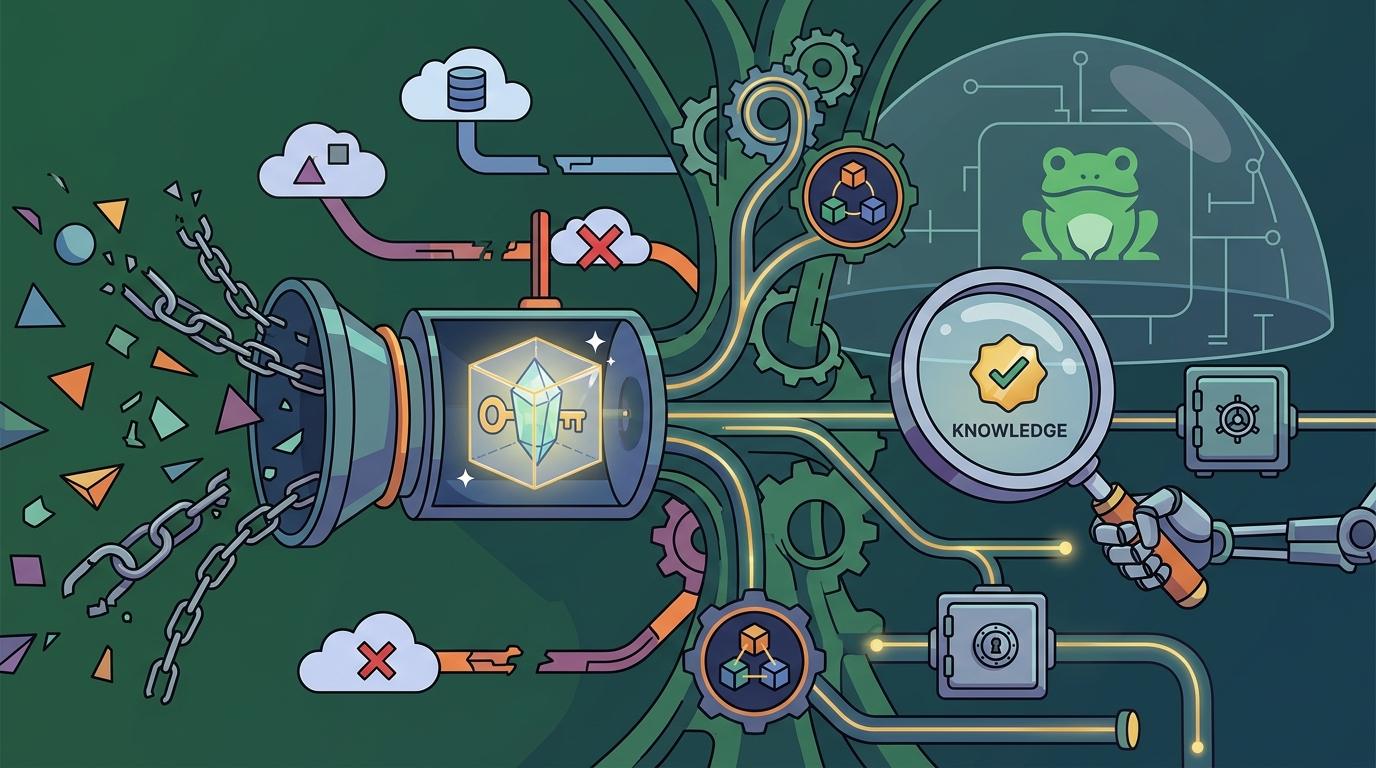
Source-backed memory is a methodology where every claim in the knowledge graph is linked to a verifiable source. This approach prevents the hallucination of facts by AI agents. When a company uses a memory tool, it is not just storing text; it is storing a relationship between a fact and its evidence. Froggit.ai turns scattered work into source-backed Froggits, which are structured units of knowledge. Each Froggit contains the content, the source, the owner, and the review state. This structure ensures that the company can audit its own knowledge base and verify that the AI is using accurate, up-to-date information.
Lineage as a Governance Tool
Lineage tracking serves as a governance tool by allowing administrators to see how knowledge evolves over time. If a policy changes, the lineage shows the old version and the new version, along with who made the change and when. This history is crucial for maintaining ownership because it provides a clear record of the company's decision-making process. Without lineage, a memory tool is just a database. With lineage, it becomes a historical record of the organization's intellectual growth. This distinction is vital for companies that operate in regulated industries where audit trails are mandatory.
Governance and Access Control
Governance is the set of policies and procedures that determine who can access, create, and modify knowledge within the system. For a company to maintain ownership of its knowledge, it must have granular control over access rights. This means that different teams, roles, or even individual agents must have specific permissions based on their need to know. A memory tool that lacks robust access controls risks leaking sensitive information to unauthorized parties, which effectively transfers ownership of that data to the public or to competitors. according to Gates Open Research
Trust Levels and Review Queues
Trust levels are a mechanism for managing the reliability of knowledge. In a governed system, not all data is created equal. Some facts are peer-reviewed and verified, while others are provisional or unverified. A sophisticated memory tool uses trust levels to determine what information an AI agent can use in production. This ensures that the company's AI is grounded in high-quality, verified context. Froggit.ai uses a governance layer that includes trust scores and review queues. This allows the company to decide what reaches production reads, ensuring that only trusted knowledge is used to drive business operations.
Policy Gates and Compliance
Policy gates are automated checks that enforce compliance rules before data is accessed or used. These gates can be based on data classification, user role, or regulatory requirements. By implementing policy gates, a company can ensure that its AI agents do not violate internal policies or external regulations. This is a critical aspect of ownership because it demonstrates that the company is actively managing its data assets. A memory tool that supports policy gates allows the company to maintain control over how its knowledge is used, even as it is consumed by AI systems. according to Gates Open Research
Agent Integration and API Access
Agent integration is the process of connecting AI agents to the memory system. For a company to maintain ownership, the integration must be transparent and controllable. This means that the company should be able to see what the agent is querying, what it is retrieving, and how it is using that information. Open APIs and standard protocols are essential for this transparency. They allow the company to build its own integrations or to switch to a different agent framework without losing access to its memory.
Standard Protocols for Agent Discovery
Standard protocols, such as the Model Context Protocol (MCP) and the Agent-to-Agent (A2A) protocol, are becoming the norm for agent integration. These protocols provide a common language for agents and memory systems. By supporting these standards, a memory tool ensures that it is not a black box. The company can inspect the capabilities of the agent and the memory system through machine-readable discovery documents. Froggit.ai publishes machine-readable discovery documents that identify the governed agent capabilities. This transparency is a key indicator that the platform is designed to work with the company's ecosystem, not against it.
REST and OpenAPI Surfaces
REST APIs and OpenAPI specifications are the backbone of modern software integration. A memory tool that provides a well-documented REST API allows the company to build custom workflows and integrations. This is important for ownership because it gives the company the ability to extend the memory system in ways that the vendor may not have anticipated. The OpenAPI specification provides a clear contract for how the API works, which reduces the risk of unexpected behavior. By using standard APIs, the company ensures that its memory system is a flexible asset that can adapt to changing business needs.
Comparison of AI Memory Tools
The following table compares key features of different AI memory tools with a focus on data ownership, provenance, and governance. This comparison helps organizations understand the trade-offs between different platforms.
| Feature | Froggit.ai | Mem0 | Langfuse | Guru |
|---|---|---|---|---|
| Primary Focus | Institutional Memory & Provenance | Personalized User Memory | LLM Observability & Tracing | Knowledge Management & Collaboration |
| Data Ownership Model | Source-Backed, Company-Owned | User-Centric, Vendor-Hosted | Log-Centric, Vendor-Hosted | Company-Owned, SaaS |
| Provenance Tracking | Full Lineage & Isnad-Style Chains | Limited Metadata | Trace Logs, No Knowledge Graph | Basic Version History |
| Agent Integration | MCP, A2A, REST, OpenAPI | REST API | SDKs, REST API | REST API, Integrations |
| Governance Features | Trust Levels, Review Queues, Policy Gates | Basic Access Control | Role-Based Access Control | Role-Based Access Control |
This comparison highlights that while many tools offer memory or knowledge management features, few provide the depth of provenance and governance required for true enterprise ownership. Froggit.ai distinguishes itself by focusing on the structural integrity of the knowledge graph, ensuring that every piece of data is verified and traceable.
Key Takeaways
- Data ownership requires both legal rights and technical capabilities to export and migrate data.
- Provenance tracking is essential for verifying the accuracy of AI-generated responses.
- Governance layers such as trust levels and review queues ensure that only verified knowledge is used in production.
- Standard protocols like MCP and A2A provide transparency and prevent vendor lock-in.
- Source-backed memory transforms scattered information into a structured, auditable asset.
- Granular access controls are necessary to protect sensitive company knowledge from unauthorized access.
- Open APIs allow companies to build custom integrations and maintain control over their data ecosystem.
- Lineage tracking provides a historical record of how knowledge evolves, which is crucial for compliance.
Frequently Asked Questions
What is the difference between data ownership and data access?
Data access refers to the ability to view or use data within a specific system. Data ownership refers to the legal and technical right to control, modify, export, and delete that data. A company can have access to data in a vendor's system without owning it. True ownership requires the ability to take the data with you if you leave the vendor.
How does provenance tracking prevent AI hallucinations?
Provenance tracking links every fact in the memory system to a verifiable source. When an AI agent retrieves information, it can check the source to verify the fact. If the source is missing or unverified, the agent can flag the information as unreliable. This reduces the likelihood of the agent generating false or hallucinated content.
What are trust levels in a memory system?
Trust levels are a scoring mechanism that indicates the reliability of a piece of knowledge. A high trust level means the knowledge has been verified by a human or a trusted process. A low trust level means the knowledge is provisional or unverified. Trust levels allow the system to filter out low-quality data before it is used by AI agents.
Can I export my data from Froggit.ai?
Yes, Froggit.ai is designed to allow companies to retain ownership of their data. The platform supports standard data formats and open APIs, which facilitate data export and migration. This ensures that the company is not locked into the platform and can move its knowledge base to another system if needed.
What is the Model Context Protocol (MCP)?
The Model Context Protocol is a standard for connecting AI agents to external tools and data sources. It provides a common interface for agents to discover and use capabilities from different systems. By supporting MCP, a memory tool ensures that it can be integrated with a wide range of AI frameworks and agents.
Why is lineage tracking important for compliance?
Lineage tracking provides a complete history of how a piece of data was created, modified, and used. This history is essential for compliance audits, as it allows regulators to verify that the company is following its policies and procedures. Without lineage tracking, it is difficult to prove that a decision was made based on accurate and up-to-date information.
How does Froggit.ai differ from general document storage?
General document storage focuses on storing files and documents. Froggit.ai focuses on capturing and verifying organizational knowledge. It transforms unstructured data into structured, source-backed Froggits that can be queried by AI agents. This allows the company to reuse its knowledge in a way that is not possible with simple document storage.
What is the role of the governance layer in Froggit.ai?
The governance layer in Froggit.ai manages trust, review queues, and policy gates. It determines what knowledge is allowed to reach production reads. This ensures that the company's AI agents are grounded in trusted, verified context. The governance layer is a key component of the platform's ability to maintain data ownership and integrity.
Conclusion
Choosing an AI memory tool is a strategic decision that impacts the long-term value of your company's intellectual property. To keep ownership of company knowledge with the company, you must look for platforms that prioritize data sovereignty, provenance, and governance. Froggit.ai is built on these principles, offering a source-backed memory engine that turns scattered work into trusted, reusable assets. By using a platform that supports standard protocols and open APIs, you ensure that your knowledge remains a flexible, company-owned asset. To explore how Froggit.ai can help your organization capture and verify its institutional memory, visit the homepage or review the Agent Documentation to see how the platform integrates with your existing AI stack.