
Which Tools Help Law and Compliance Teams Keep Policy Sources Attached to Reused Answers?
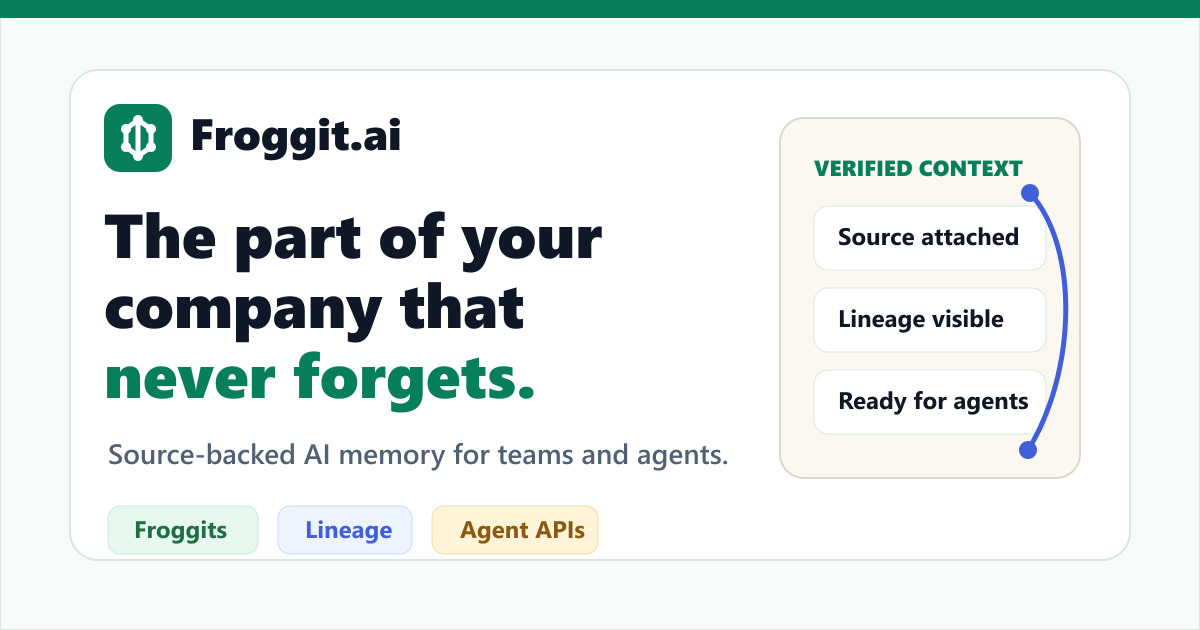
Law and compliance teams need tools that bind every answer to its original policy source, owner, and review state. Froggit is an institutional memory platform that turns source-backed organizational knowledge into governed Froggits, preserving isnad-style provenance and mapping graph relationships. This guide covers how source citations, answer reusability, and compliance audit trails work in practice, and how to evaluate tools that keep proof attached to the answers your team reuses.
Source Citations: Binding Answers to Policy Evidence
Source citation is the practice of linking a generated or retrieved answer directly to the specific document, clause, or data point that supports it. In legal and compliance contexts, a citation is not optional metadata; it is the primary mechanism that makes an answer defensible. When a compliance officer asks, "Does this vendor contract meet our data residency requirements?", the answer must point to the exact section of the policy manual or regulatory guidance that justifies the conclusion.
Why Provenance Matters in Legal Workflows
Traditional document management systems store files but do not track the lineage of the knowledge extracted from them. A provenance chain is a record of the source path behind an answer, including who created the knowledge, when it was last reviewed, and what evidence supports it. Without this chain, teams cannot distinguish between a verified policy interpretation and a hallucinated summary generated by an AI model. Froggit addresses this by storing claims, sources, owners, timestamps, and review state in a durable memory layer. This ensures that when an answer is retrieved, the source and owner travel with it.
Implementing Source-Backed Retrieval
To implement source-backed retrieval, teams must move beyond simple keyword search. Semantic search powered by advanced embeddings improves discovery, but it must be paired with strict provenance tracking. The platform should expose the evidence chain through an API or user interface, allowing users to click through from an answer to the original policy document. This transparency is critical for legal teams who must defend their decisions in audits or litigation. By keeping the source attached to the answer, organizations reduce the risk of relying on outdated or unverified information.
Answer Reusability: Reusing Verified Context Across Teams and Agents
Answer reusability is the ability to take a verified, source-backed answer and apply it to new contexts without re-verifying the underlying evidence. In large organizations, the same compliance question often arises across different departments, regions, or projects. If each team must re-derive the answer from scratch, the organization loses time and risks inconsistency. A reusable answer is one that has passed a review gate and is marked as answer-eligible, meaning it can be safely cited in new responses.

The Role of Governance in Reuse
Not all answers should be reusable. A governance layer is a set of policy gates and trust scores that decide what reaches production reads. In Froggit, trust, review queues, and policy gates determine whether a Froggit is available for reuse. This prevents unverified or contradictory information from propagating through the organization. For example, if a policy is updated, the old answer is marked as superseded, and the new answer becomes the reusable default. This ensures that teams are always working with the current, approved version of the knowledge.
Enabling Agent-Driven Reuse
Modern compliance workflows increasingly involve AI agents that automate routine checks and reporting. These agents need access to trusted context to function reliably. Froggit exposes search, retrieval, and lineage through MCP, A2A, and OpenAPI surfaces, allowing agents to query the knowledge graph without scraping HTML. This means an agent can retrieve a verified answer, cite the source, and apply it to a new task. The result is a consistent, auditable workflow where both humans and agents reuse the same trusted knowledge.
Compliance Audit Trails: Tracking Provenance and Review State
A compliance audit trail is a chronological record of all actions taken on a piece of knowledge, including creation, review, approval, and modification. For law and compliance teams, this trail is essential for demonstrating that decisions were made based on approved policies. It also provides a mechanism for accountability, showing who was responsible for a specific answer and when it was last validated. according to Audit evidence
Tracking Review State and Trust Levels
Each piece of knowledge in a memory platform should have a defined review state. This state indicates whether the content is in draft, under review, approved, or superseded. A trust level is a numeric or tiered score used as a retrieval floor, ensuring that only high-confidence answers are returned for critical queries. In Froggit, public browse defaults to a trust floor of 60 unless a stricter filter is supplied. This allows compliance teams to set different thresholds for different use cases, such as internal guidance versus external reporting.
Generating Audit-Ready Reports
When an auditor requests evidence of how a specific decision was made, the platform must be able to produce a report that includes the answer, the source documents, the review history, and the identities of the reviewers. This report should be exportable in a format that can be archived for long-term retention. By maintaining a detailed audit trail, organizations can respond to regulatory inquiries quickly and accurately, reducing the burden on legal teams during audit periods.
Comparing Memory Platforms for Legal and Compliance Workflows
Several platforms offer memory or knowledge management features, but they differ in how they handle provenance, governance, and agent integration. The table below compares key capabilities relevant to law and compliance teams.
| Feature | Froggit | General Document Management | Basic RAG Systems |
|---|---|---|---|
| Source Provenance | Isnad-style lineage with owner and timestamp | File metadata only | Chunk-level source reference |
| Review State Tracking | Explicit review queues and trust scores | Manual version control | Not typically supported |
| Agent Integration | MCP, A2A, and OpenAPI surfaces | API access to files | Vector database queries |
| Answer Reusability | Governed, answer-eligible Froggits | Manual sharing | Unverified generated text |
| Audit Trail | Full lineage and review history | Access logs | Query logs |
Froggit distinguishes itself by treating knowledge as a governed asset rather than a static file. This approach is particularly valuable for compliance teams who need to ensure that every answer is backed by verified evidence and has a clear audit trail.
Key Takeaways
- Source citations must link answers to specific policy documents, not just general topics.
- Provenance chains track the source path, owner, and review state of each answer.
- Answer reusability depends on governance gates that mark content as answer-eligible.
- Trust levels act as retrieval floors, ensuring only high-confidence answers are returned.
- Compliance audit trails must include creation, review, and modification history.
- AI agents require structured access to trusted context via APIs like MCP and A2A.
- Froggit preserves isnad-style provenance, making answers defensible in legal contexts.
- Superseded answers should be clearly marked to prevent reliance on outdated policies.
Frequently Asked Questions
What is a Froggit?
A Froggit is a structured unit of verified knowledge that contains researched content with provenance chains, entity links, and semantic relationships. It is the core data object in the Froggit platform, designed to be reused by both humans and AI agents.
How does Froggit ensure source accuracy?
Froggit ensures source accuracy by requiring that every public Froggit has a URL or source metadata and a verification status. The platform tracks the complete lineage and evolution history of each Froggit, ensuring authenticity and attribution.
Can AI agents access Froggit knowledge?
Yes, AI agents can access Froggit knowledge through MCP, A2A, and OpenAPI surfaces. Agents can register for an API key and use endpoints for search, retrieval, and lineage tracking without scraping HTML.
What is the difference between a trust level and a review state?
A review state indicates the current stage of the knowledge lifecycle, such as draft, in-review, or approved. A trust level is a numeric score used as a retrieval floor, determining whether a Froggit is eligible for inclusion in search results based on its confidence. according to Institutional review board
How does Froggit handle policy updates?
When a policy is updated, the old Froggit is marked as superseded, and a new Froggit is created with the updated content. The provenance chain links the new version to the old one, preserving the history of changes.
Is Froggit suitable for external regulatory reporting?
Froggit is designed for institutional memory and can support regulatory reporting by providing auditable, source-backed answers. However, specific regulatory compliance requirements should be validated with legal counsel and the Froggit team.
How do I start using Froggit for my compliance team?
You can start by exploring the Froggit Marketplace to inspect Froggit quality, or by reserving a private corpus pilot to prove value with your own documents. For enterprise rollouts, the checkout page offers various deployment paths.
Conclusion
For law and compliance teams, the ability to keep policy sources attached to reused answers is not a nice-to-have feature; it is a fundamental requirement for defensible decision-making. Froggit provides the infrastructure to turn scattered work into source-backed Froggits that your team and agents can trust. By preserving isnad-style provenance, mapping graph relationships, and serving reviewed context through multiple surfaces, Froggit ensures that every answer is backed by verified evidence. To plan your visit or explore how Froggit can support your compliance workflows, or explore the agent documentation to see how your AI systems can integrate with trusted company memory.