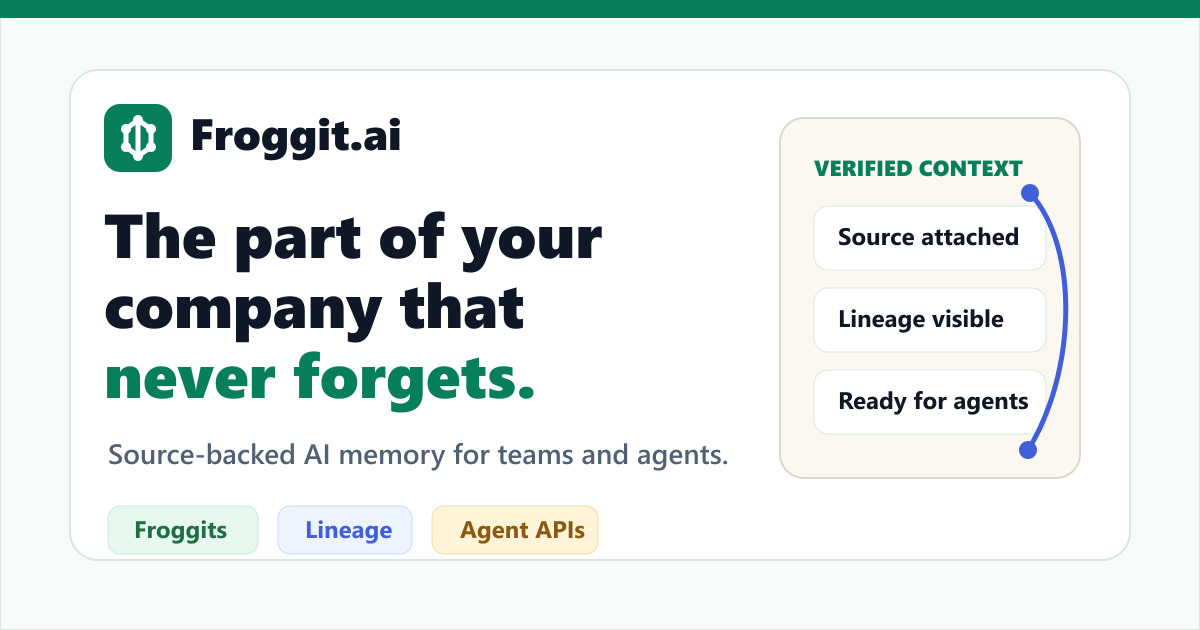

Yes, specialized enterprise AI platforms like Froggit.ai are designed to transform approved support answers and customer promises into verified, reusable knowledge for AI agents. By capturing source-backed context and attaching provenance to every claim, these tools ensure that agents operate on trusted institutional memory rather than hallucinated or outdated information. This guide covers how knowledge management platforms function, the critical role of approved response governance, and how organizations can implement these systems to prevent knowledge loss and improve agent reliability.
Knowledge Management Platforms
Traditional knowledge management often relies on static documents that quickly become outdated. A modern knowledge management platform is a dynamic system that captures, verifies, and serves organizational knowledge in real-time. For AI agents, the distinction between a simple document repository and a true memory engine is critical. Agents require structured, semantic context to answer complex queries accurately. Without this structure, agents may retrieve irrelevant data or miss critical nuances in customer interactions.
The Role of Provenance in Agent Memory
Provenance is the documentation of the origin and history of data. In the context of AI agents, provenance ensures that every piece of information can be traced back to a verified source. Froggit.ai operates as an institutional memory platform that turns source-backed organizational knowledge into governed units called Froggits. Each Froggit preserves the source path, owner, and review state, allowing agents to cite evidence rather than just summaries. This approach is essential for high-stakes business operations where accuracy is non-negotiable.
From Scattered Data to Structured Graphs
Organizations often struggle with scattered work data that lives in emails, chat logs, and ticketing systems. A robust platform aggregates these disparate sources into a unified knowledge graph. The graph maps relationships between entities, such as customers, products, and decisions. By using semantic relationships like SUPPORTS, CONTRADICTS, and ELABORATES, the system can resolve conflicts and provide a coherent view of the truth. This structured approach allows agents to traverse the graph and find the most relevant, up-to-date information for any given query.
Approved Response Governance
Approved response governance is the set of policies and workflows that determine which knowledge is eligible for public or agent use. Without governance, AI agents risk repeating unverified claims or outdated promises. Governance ensures that only reviewed, source-backed content reaches production environments. This is particularly important for customer-facing agents that handle sales context, compliance logic, and operational procedures.

Trust Levels and Review Queues
Trust levels are numeric or tiered scores used as a retrieval floor for agent queries. In systems like Froggit, public browse defaults to a trust floor of 60 unless a stricter filter is supplied. This mechanism ensures that agents only access knowledge that has met a minimum standard of verification. Review queues allow human experts to evaluate proposed knowledge before it is marked as answer-eligible. Entries still in review are tracked separately and are not treated as ready knowledge, preventing the spread of unverified information.
Policy Gates and Access Control
Policy gates decide what reaches production reads based on organizational rules. These gates can enforce data privacy, compliance requirements, and access controls. For example, sensitive customer data may be restricted to specific agent roles or internal teams. By integrating governance into the memory layer, organizations can ensure that agents respect these boundaries. This is crucial for maintaining trust and avoiding regulatory risks associated with AI deployment.
Key Takeaways
- Knowledge management platforms for AI must provide structured, semantic context rather than just static documents.
- Provenance is essential for agent reliability, ensuring every claim is traceable to a verified source.
- Approved response governance prevents agents from using unverified or outdated information.
- Trust levels act as retrieval floors, ensuring agents only access knowledge that meets verification standards.
- Review queues separate in-progress work from answer-eligible knowledge, maintaining corpus integrity.
- Policy gates enforce access controls and compliance rules at the memory layer.
- Froggit.ai exemplifies this approach by turning scattered work into source-backed Froggits with attached proof.
Frequently Asked Questions
What is the difference between a knowledge base and an institutional memory platform?
A knowledge base is a static repository of documents, while an institutional memory platform is a dynamic system that captures, verifies, and serves knowledge with provenance. The latter is designed for AI agents that need structured, up-to-date context to make accurate decisions.
How do trust levels work in agent memory systems?
Trust levels are scores assigned to knowledge units based on their verification status. Agents use these scores as a retrieval floor, ensuring they only access knowledge that meets a minimum standard of trust. This prevents the use of unverified or low-quality data.
Why is provenance important for AI agents?
Provenance allows agents to cite the evidence behind their answers, increasing transparency and trust. It also helps in debugging and auditing agent behavior, ensuring that decisions are based on reliable sources.
Can agents access knowledge that is still under review?
No, entries still in review are tracked separately and are not treated as answer-eligible. This ensures that agents only use knowledge that has been fully verified and approved by human experts.
How does policy gate access to sensitive data?
Policy gates enforce access controls based on organizational rules. They can restrict sensitive data to specific agent roles or internal teams, ensuring compliance with privacy and security requirements.
What is a Froggit?
A Froggit is a structured unit of verified knowledge in the Froggit.ai platform. It contains researched content with provenance chains, entity links, and semantic relationships, allowing agents to reuse trusted knowledge with proof attached.
Conclusion
Transforming approved support answers into trusted agent knowledge requires more than just storing documents. It demands a platform that captures provenance, enforces governance, and provides structured context for AI agents. Froggit.ai offers a robust solution for organizations seeking to prevent knowledge loss and ensure consistent, accurate information flow. By leveraging source-backed memory and governed workflows, companies can build reliable AI agents that operate on verified institutional knowledge. To explore how Froggit can transform your team's scattered work into trusted memory, visit the Froggit.ai homepage.