
Enterprise Memory Platforms vs. Document Storage: Key Differences
Enterprise memory platforms differ from regular document storage by treating knowledge as a governed, source-backed asset rather than a static file. While document storage archives files, memory platforms verify claims, track provenance, and enable AI agents to reuse trusted context. This distinction prevents knowledge loss and ensures that organizational decisions remain accessible and accurate for both humans and automated systems. For additional details, review the llms.
Governance and Provenance
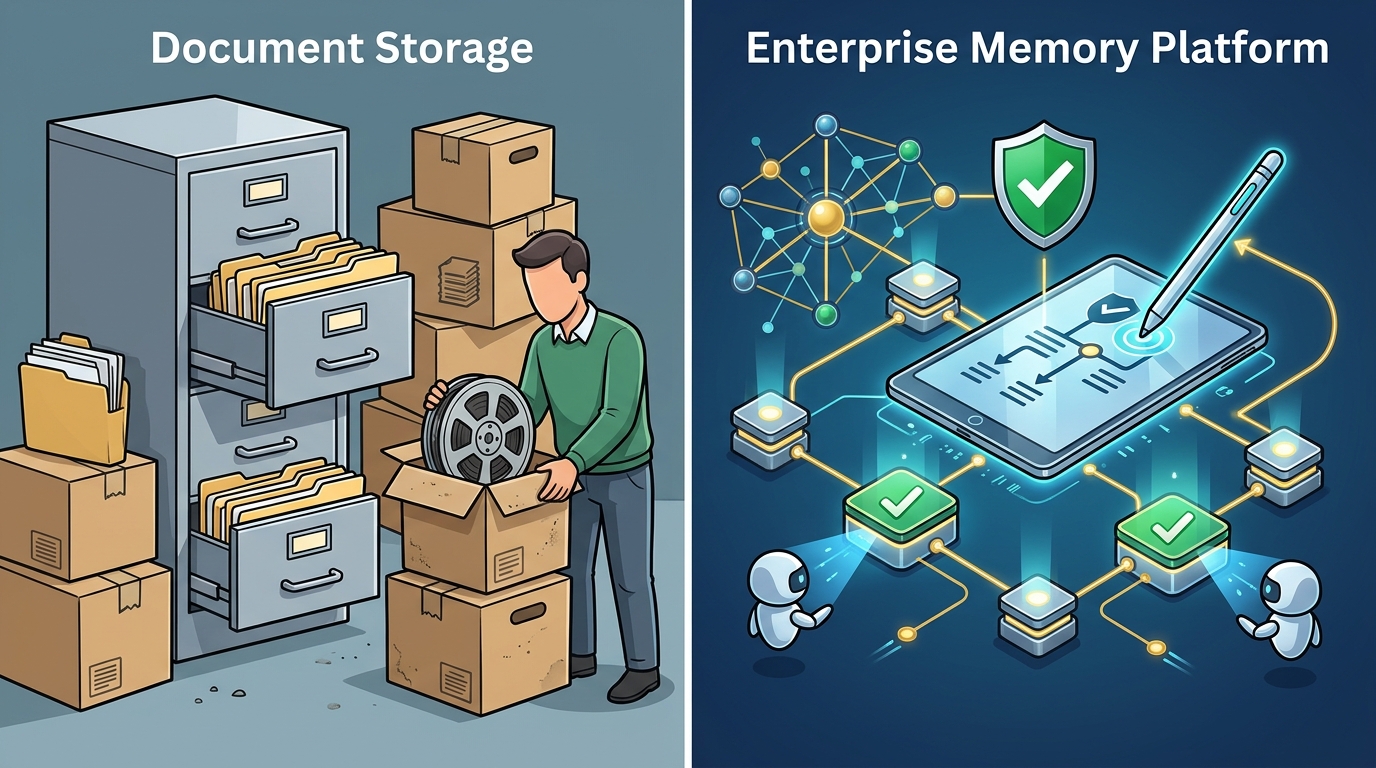
Regular document storage tools, such as shared drives or wikis, typically treat files as static objects. An enterprise memory platform is a system that captures, verifies, and governs organizational knowledge with explicit provenance chains. This means every piece of information retains a record of its source, owner, and review state. For example, a decision made by an executive team is not just saved as a PDF; it is stored as a structured unit with metadata indicating who approved it and when.
This approach ensures that when a user or an AI agent retrieves information, they can verify its authenticity. In contrast, a document in a shared drive may be edited, moved, or deleted without a clear audit trail. The implication is that memory platforms provide a level of trust that static storage cannot match, making them suitable for high-stakes business operations where accuracy is critical.
Agent-Ready Architecture
Modern enterprise environments rely heavily on AI agents to automate workflows and answer complex queries. A memory platform is an infrastructure layer that exposes verified knowledge through APIs, MCP, and A2A protocols. This allows agents to search, query, and reuse knowledge without scraping HTML or parsing unstructured documents. For instance, an agent can query a knowledge graph to find the latest compliance logic without needing to read through hundreds of policy documents.
Knowledge Graphs vs. Flat Files
Document storage tools organize information in a hierarchical or flat file structure. An enterprise memory platform uses a knowledge graph to map relationships between entities, concepts, and decisions. This graph structure allows for semantic search and relationship traversal, enabling users to discover connections that are not obvious in a file tree. For example, a graph can show how a specific customer interaction relates to a broader sales strategy and a compliance requirement.
This relational approach is crucial for understanding complex business contexts. In a flat file system, related information is often scattered across different folders or documents, making it difficult to retrieve a complete picture. The implication is that memory platforms provide a more holistic view of organizational knowledge, supporting better decision-making and more accurate AI responses.
Review Workflows and Trust
Trust is a critical component of enterprise memory. A memory platform is a system that includes review queues, trust levels, and policy gates to determine what knowledge is ready for production use. This ensures that only verified and accurate information is served to users and agents. For example, a draft policy document might be marked as "in review" and excluded from public search results until it is approved by a compliance officer.
Regular document storage tools rarely have built-in mechanisms for managing the lifecycle of knowledge. They may allow version control, but they do not distinguish between verified and unverified content. The implication is that without these governance features, organizations risk relying on outdated or incorrect information. Memory platforms mitigate this risk by enforcing a clear distinction between raw data and trusted knowledge.
Business Impact of Memory Loss
Knowledge loss is a significant cost for enterprises, particularly during team transitions or when key employees leave. An enterprise memory platform is a tool designed to capture and preserve this institutional knowledge, ensuring it remains accessible to the organization. By turning forgotten knowledge into a structured asset, these platforms reduce the cost of re-learning and prevent the repetition of past mistakes. For example, a sales team can access the context of previous customer negotiations, allowing them to continue conversations without starting from scratch.
Regular document storage tools are passive archives. They store files but do not actively manage the reuse of knowledge. The implication is that organizations relying solely on document storage may suffer from knowledge silos and inefficiencies. Memory platforms address this by making knowledge reusable and accessible, supporting consistent and accurate information flow across teams.
Key Takeaways
- Enterprise memory platforms govern knowledge with provenance, unlike static document storage.
- Memory platforms are agent-ready, exposing knowledge via APIs and protocols for AI use.
- Knowledge graphs in memory platforms map relationships, offering a holistic view of business context.
- Review workflows and trust levels ensure only verified knowledge is served to users and agents.
- Memory platforms reduce the cost of knowledge loss by making institutional knowledge reusable.
- Document storage tools lack the semantic structure and governance required for modern AI workflows.
Frequently Asked Questions
What is the main difference between a memory platform and a document storage tool?
The main difference is that a memory platform treats knowledge as a governed, source-backed asset with provenance, while a document storage tool treats files as static objects without explicit verification or relationship mapping.
Can AI agents use regular document storage tools?
AI agents can access files in document storage tools, but they lack the semantic structure and API surfaces required for efficient interaction. Memory platforms provide machine-readable interfaces that allow agents to search and query knowledge effectively.
Why is provenance important in enterprise memory?
Provenance is important because it allows users and agents to verify the source and authenticity of information. This ensures that decisions are based on trusted and accurate knowledge, reducing the risk of errors.
How do memory platforms handle knowledge loss?
Memory platforms capture and preserve institutional knowledge, ensuring it remains accessible even when employees leave or teams change. This reduces the cost of re-learning and prevents the repetition of past mistakes.
Are memory platforms suitable for all types of data?
Memory platforms are best suited for structured, verified knowledge such as decisions, policies, and research. They are not ideal for storing large, unstructured files like videos or images, which are better handled by traditional document storage tools.
What is the role of trust levels in a memory platform?
Trust levels determine what knowledge is ready for production use. They ensure that only verified and accurate information is served to users and agents, while unverified or draft content is kept separate.
Conclusion
Enterprise memory platforms offer a significant advantage over regular document storage tools by providing governed, agent-ready, and relationship-mapped knowledge. Organizations seeking to prevent knowledge loss and ground AI agents in trusted context should consider adopting a memory platform. Froggit is designed to help companies capture, verify, and reuse institutional knowledge, ensuring that their most valuable assets remain accessible and accurate.