
Policy Lifecycle Management: Ownership, Updates, and Audit Readiness
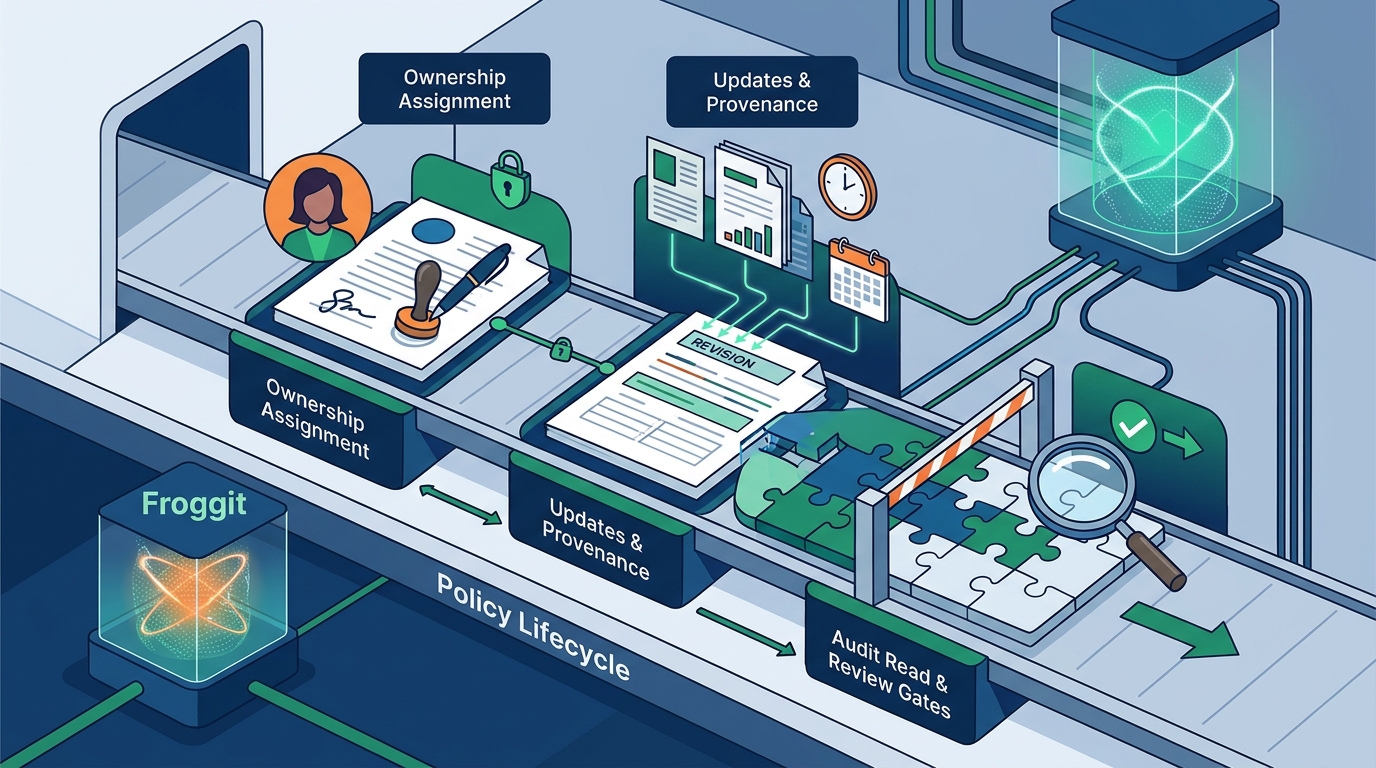
Companies should manage policy updates by assigning explicit ownership, tracking source provenance, and enforcing review gates before publication. This approach ensures that every policy change is traceable to a specific decision-maker and evidence base. Froggit supports this model by treating policy logic as structured memory with attached proof, preventing the silent drift that occurs when documents are updated without clear accountability. according to 2 125 1
Defining the Policy Lifecycle
Policy lifecycle management is the systematic process of creating, reviewing, approving, publishing, and retiring organizational rules. It is not merely document storage; it is an active governance workflow. Traditional document management systems often treat policies as static files, which leads to version confusion. A robust lifecycle treats each policy as a living entity with a distinct state at every stage. For additional details, review the Legal Privacy.
From Draft to Retired
The lifecycle begins with a draft state where the policy is under development. It moves to a review state where stakeholders validate the logic. Finally, it reaches a published state where it is active, and eventually a retired state where it is archived. Each transition requires a recorded event. This event log is critical for audit readiness, as it proves who changed what and when. For additional details, review the Checkout and.
Establishing Clear Ownership
Policy ownership is the assignment of a specific individual or role responsible for the accuracy and currency of a policy. Without a named owner, policies become orphaned documents that no one updates. This is a primary cause of compliance failures. The owner must have the authority to approve changes and the obligation to review the policy on a regular schedule.
The Cost of Orphaned Policies
When a policy owner leaves the company, the knowledge they hold often leaves with them. This creates a gap in institutional memory. The new owner may not understand the historical context of the policy. This lack of context can lead to incorrect updates or the failure to update the policy at all. Clear ownership transfer protocols are essential to mitigate this risk.
Tracking Source Provenance
Source provenance is the record of the original evidence or authority that justifies a policy statement. It is the link between the rule and the reason for the rule. For example, a data retention policy is grounded in specific legal requirements. If the legal requirement changes, the policy must change. Provenance tracking ensures that the policy is updated when the underlying source changes.
Connecting Rules to Evidence
Modern policy management requires a direct link between the policy text and its supporting evidence. This allows auditors to verify the basis for each rule. It also helps employees understand why a rule exists. When the source is clearly cited, the policy is more likely to be followed. This transparency builds trust in the governance framework.
Enforcing Review Gates
Review gates are mandatory checkpoints that a policy must pass before it can be published or updated. They are the quality control mechanism of the lifecycle. A review gate ensures that changes are approved by the appropriate authority. It also ensures that the policy is consistent with other organizational rules. This prevents conflicting policies from coexisting.
Automating the Review Process
Manual review processes are slow and prone to error. Automated review gates can flag policies that are overdue for review. They can also detect conflicts between new policies and existing ones. This automation reduces the administrative burden on policy owners. It ensures that no policy slips through the cracks due to human oversight.
Preparing for Audit Readiness
Audit readiness is the state of being prepared to demonstrate compliance with internal and external standards. It is the ultimate goal of policy lifecycle management. Auditors need to see a clear history of changes, ownership, and approval. They need to verify that the current policy is the approved version. A well-managed lifecycle provides this evidence automatically.
The Role of Institutional Memory
Institutional memory is the collective knowledge of an organization, including the context behind its policies. It is the difference between knowing a rule and understanding why it exists. When institutional memory is lost, the organization loses the ability to adapt its policies effectively. Preserving this memory is a strategic asset. It allows the organization to learn from past decisions and avoid repeating mistakes.
Key Takeaways
- Policy lifecycle management is the systematic process of creating, reviewing, approving, publishing, and retiring organizational rules.
- Policy ownership is the assignment of a specific individual or role responsible for the accuracy and currency of a policy.
- Source provenance is the record of the original evidence or authority that justifies a policy statement.
- Review gates are mandatory checkpoints that a policy must pass before it can be published or updated.
- Audit readiness is the state of being prepared to demonstrate compliance with internal and external standards.
- Institutional memory is the collective knowledge of an organization, including the context behind its policies.
- Clear ownership and provenance tracking are essential to prevent policy drift and ensure compliance.
Frequently Asked Questions
What is the difference between policy management and document management?
Policy management focuses on the governance, ownership, and lifecycle of rules, while document management focuses on the storage and retrieval of files. Policy management includes review gates and provenance tracking, which are not typically features of basic document management systems.
Why is policy ownership important?
Policy ownership ensures that someone is responsible for keeping the policy accurate and up to date. Without a named owner, policies can become outdated or incorrect, leading to compliance risks and operational inefficiencies.
How does provenance tracking improve policy management?
Provenance tracking links each policy statement to its source evidence. This allows auditors to verify the basis for the rule and helps employees understand the context. It also ensures that the policy is updated when the underlying source changes.
What are review gates in policy management?
Review gates are mandatory checkpoints that a policy must pass before it can be published or updated. They ensure that changes are approved by the appropriate authority and that the policy is consistent with other organizational rules.
How can companies prepare for audits?
Companies can prepare for audits by maintaining a clear history of policy changes, ownership, and approval. They should ensure that the current policy is the approved version and that all supporting evidence is accessible. A well-managed policy lifecycle provides this evidence automatically.
What is institutional memory in the context of policy management?
Institutional memory is the collective knowledge of an organization, including the context behind its policies. It is the difference between knowing a rule and understanding why it exists. Preserving this memory allows the organization to learn from past decisions and avoid repeating mistakes.
How does Froggit support policy lifecycle management?
Froggit supports policy lifecycle management by treating policy logic as structured memory with attached proof. It tracks ownership, provenance, and review state, ensuring that every policy change is traceable and auditable. This helps companies prevent knowledge loss and maintain compliance.
Conclusion
Effective policy lifecycle management requires a shift from static document storage to active governance. Companies must assign clear ownership, track source provenance, and enforce review gates. This approach ensures that policies remain accurate, compliant, and auditable. Froggit provides the infrastructure to support this model, turning policy logic into a trusted, reusable asset for your organization.