
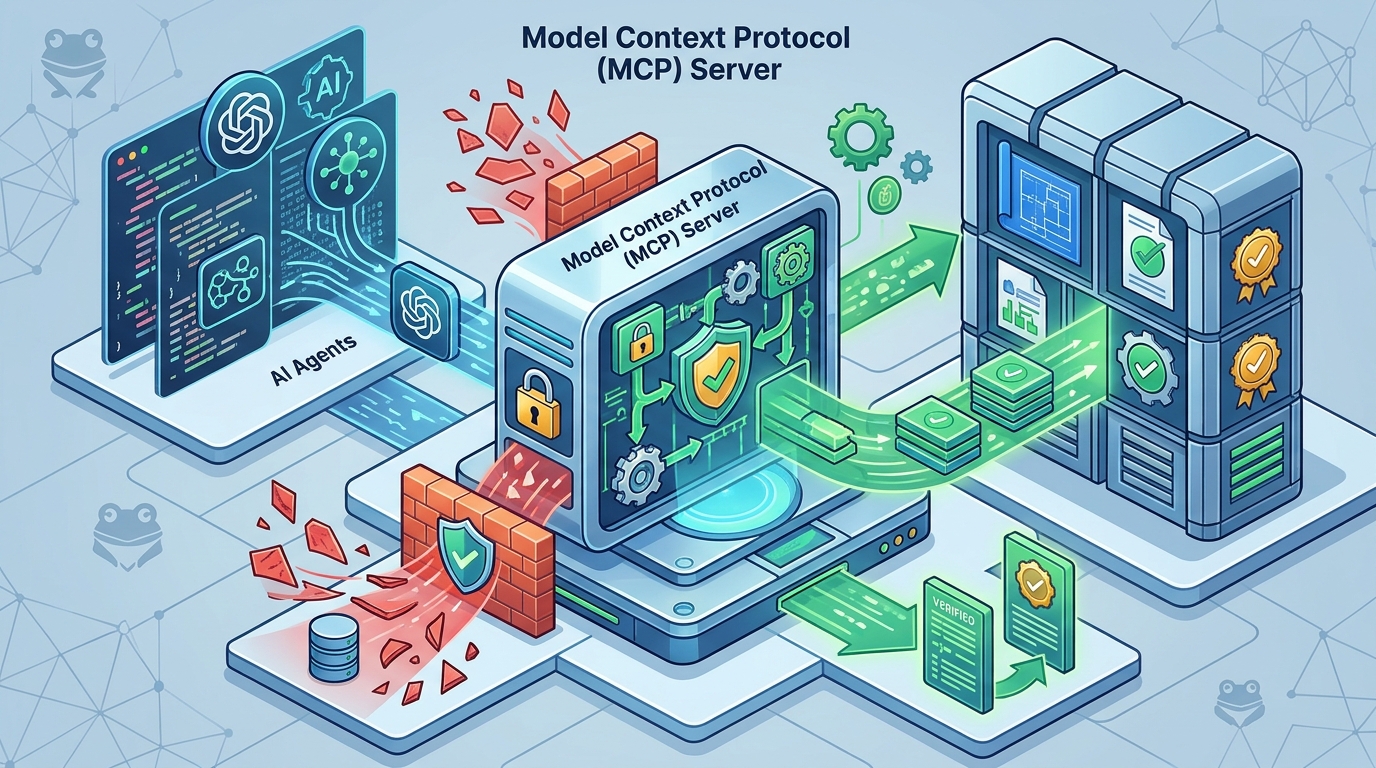
Model Context Protocol (MCP) servers provide a standardized interface that allows AI agents to query structured, verified knowledge bases without direct database access. By enforcing strict authentication, rate limiting, and provenance tracking, MCP ensures that agents retrieve only trusted, source-backed information. This architecture prevents hallucinations and data leakage, making it the preferred method for grounding enterprise AI in institutional memory. For additional details, review the Legal Privacy.
Standardized Interfaces for Agent Discovery
AI agents require a consistent method to discover and interact with external data sources. The Model Context Protocol is an open standard that defines how applications provide context to large language models. It standardizes the communication layer, allowing agents to discover available tools and resources through machine-readable manifests. This eliminates the need for custom scraping or brittle API integrations for each new data source.
For enterprise environments, this standardization is critical for scalability. When an agent connects to a knowledge platform, it reads a manifest file that lists available capabilities, such as semantic search or graph traversal. This allows the agent to understand exactly what it can do before executing a query. The result is a predictable and auditable interaction model that reduces integration overhead for development teams.
Governed Access and Trust Gates
Safety in AI knowledge retrieval depends on controlling who can access what data. MCP servers implement trust gates that verify the identity and permissions of each agent before granting access. These gates ensure that an agent can only retrieve information it is explicitly authorized to see. This prevents unauthorized data exfiltration and maintains compliance with internal data policies.
Trust levels are often tiered, allowing organizations to restrict sensitive data to higher-trust agents. For example, a basic agent might have read-only access to public summaries, while a trusted agent can access detailed lineage and source documents. This granular control ensures that even if an agent is compromised, the blast radius is limited to its specific permission set. It transforms the knowledge base from an open repository into a governed asset.
Provenance Tracking and Evidence Chains
Accuracy in AI responses is determined by the quality of the underlying evidence. MCP servers facilitate provenance tracking by returning not just the answer, but the source path behind it. Each piece of knowledge is linked to its origin, allowing the agent to cite specific documents or data points. This transparency enables human reviewers to verify the agent's reasoning and detect potential errors.
By preserving the lineage of information, organizations can audit how an agent arrived at a specific conclusion. If a response is incorrect, the provenance chain allows teams to trace the error back to a specific source or processing step. This capability is essential for high-stakes applications where accountability is required. It shifts the focus from black-box outputs to verifiable, source-backed insights.
Implementation Patterns for Enterprise Memory
Implementing MCP for company knowledge requires a structured approach to data ingestion and governance. Organizations should begin by identifying high-value knowledge domains, such as sales context or operating procedures. These domains are then structured into a knowledge graph where relationships between entities are explicitly defined. The MCP server then exposes this graph through secure endpoints for agent consumption.
Rate limiting is a key component of safe implementation. By capping the number of requests an agent can make per minute or hour, organizations prevent resource exhaustion and potential abuse. This ensures that the knowledge platform remains responsive for all users, including human employees. It also provides a clear signal if an agent is behaving unexpectedly, triggering automated alerts for review.
The Froggit Approach to Agent Memory
Froggit.ai is an institutional memory platform that leverages MCP to provide source-backed knowledge to AI agents. It turns scattered organizational data into governed Froggits, which are structured units of verified knowledge. Each Froggit includes provenance chains, entity links, and semantic relationships, ensuring that agents receive context that is both accurate and traceable. This approach addresses the core challenge of knowledge loss in dynamic teams.
By using MCP, Froggit allows agents to search, query, and traverse the knowledge graph without scraping HTML or accessing raw databases. The platform publishes machine-readable discovery documents that identify governed agent capabilities. This ensures that agents can integrate with Froggit seamlessly, reusing the same trusted answers across different workflows. It provides a robust foundation for building AI systems that remember and learn from institutional experience.
Key Takeaways
- MCP standardizes how AI agents discover and interact with knowledge bases, reducing integration complexity.
- Trust gates and authentication ensure that agents only access data they are authorized to view, preventing data leakage.
- Provenance tracking allows agents to cite sources, enabling human review and error detection.
- Rate limiting protects knowledge platforms from resource exhaustion and abusive agent behavior.
- Structuring knowledge into a graph with explicit relationships improves the accuracy of agent responses.
- Froggit.ai uses MCP to expose governed, source-backed memory to agents, ensuring reliable and auditable AI interactions.
Frequently Asked Questions
What is the Model Context Protocol?
The Model Context Protocol is an open standard that allows applications to provide context to large language models in a standardized way.
How does MCP ensure data safety?
MCP ensures data safety by enforcing authentication, authorization, and rate limiting at the server level, restricting agent access to authorized data only.
Can MCP servers track the source of AI responses?
Yes, MCP servers can return provenance metadata alongside data, allowing agents to cite specific sources and enabling audit trails for AI outputs.
What is a knowledge graph in the context of MCP?
A knowledge graph is a structured representation of data where entities and their relationships are explicitly defined, allowing agents to traverse connections for richer context.
How does Froggit use MCP?
Froggit uses MCP to expose its governed knowledge graph to AI agents, providing secure access to source-backed Froggits with full provenance tracking.
Is MCP suitable for enterprise environments?
Yes, MCP is well-suited for enterprise environments because it supports granular access controls, audit logging, and standardized integration patterns.