
What Does a Verified Memory Layer Actually Do for Your Organization's AI Agents?
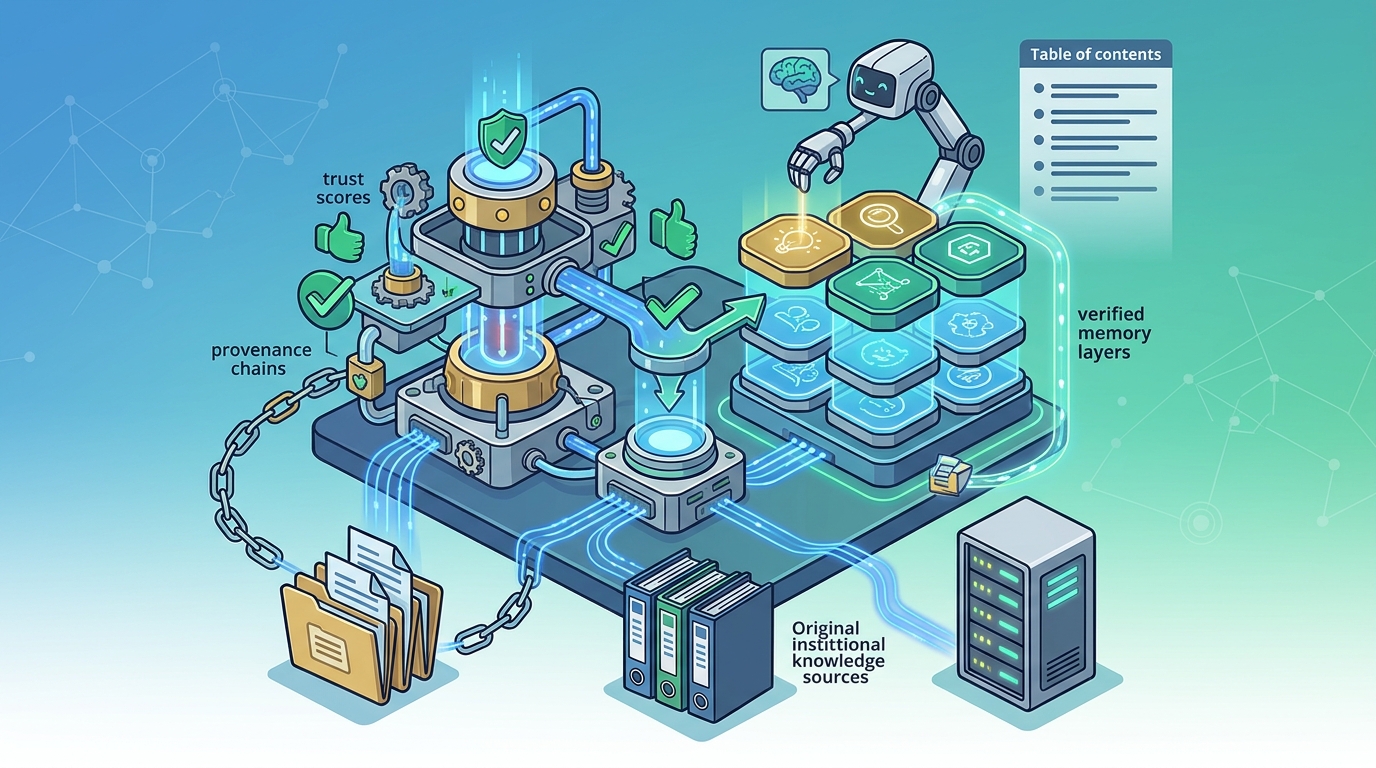
A verified memory layer provides AI agents with a governed, source-backed knowledge graph that ensures every answer is traceable to its original evidence. By attaching provenance chains and trust scores to data, it prevents hallucinations and allows agents to reuse trusted context without scraping raw documents. This infrastructure transforms scattered organizational knowledge into a durable, auditable asset that scales with your AI operations.
Provenance Chains and Evidence Integrity
Provenance is the complete lineage of a piece of information, tracking its origin, modifications, and verification status. In a standard retrieval system, an agent might retrieve a summary without knowing if the underlying source is a peer-reviewed study or an unverified forum post. A verified memory layer solves this by storing the source path directly with the claim. For example, when an agent retrieves a fact about a specific regulatory change, the memory layer returns the claim along with the URL of the primary government document and the timestamp of its last review. This ensures that the agent is not just guessing, but citing a verifiable source. For additional details, review the Legal Privacy.
Why Lineage Matters for Trust
Without lineage, AI outputs are opaque. With it, developers can audit exactly how an agent arrived at a conclusion. This is critical for high-stakes environments where a single incorrect fact can lead to compliance violations or financial loss. The memory layer acts as a gatekeeper, ensuring that only evidence-backed data enters the agent's context window.
Governance Gates and Trust Scoring
Trust scoring is a numerical or tiered system that evaluates the reliability of a knowledge unit based on its source class and review history. A verified memory layer uses these scores to filter out low-quality or unverified data before it reaches the agent. For instance, a claim sourced from a peer-reviewed journal might receive a high trust score, while a claim from an unverified blog post might be flagged for review or excluded entirely. This mechanism allows organizations to set a minimum trust floor, such as a score of 80, ensuring that agents only operate on high-confidence data. This reduces the risk of hallucinations and ensures consistent output quality across different agent deployments.
Review Queues and Policy Enforcement
Governance is not just about scoring; it is about workflow. A robust memory layer includes review queues where human experts can validate or reject claims. This human-in-the-loop approach ensures that the knowledge graph remains accurate over time. Policy gates can also enforce specific rules, such as requiring dual approval for financial data or restricting access to sensitive customer information. This level of control is essential for maintaining data integrity in enterprise environments.
Agent Integration via Standardized Protocols
Agent integration is the process of connecting AI agents to a memory layer using standardized communication protocols. Modern memory layers expose their capabilities through interfaces like Model Context Protocol (MCP) and Agent-to-Agent (A2A) communication. These protocols allow agents to search, query, and retrieve knowledge without needing to parse HTML or scrape websites. For example, an agent can send a structured query to the memory layer's API, specifying the desired trust level and result count. The memory layer then returns a JSON response containing the relevant knowledge units and their provenance metadata. This standardization simplifies development and ensures that agents can interoperate with different memory systems seamlessly.
REST and API Access
In addition to specialized protocols, memory layers often provide RESTful APIs for direct access. This allows developers to build custom integrations that fit their specific needs. For instance, a developer might build a custom tool that retrieves the lineage of a specific claim for a compliance report. The API provides endpoints for searching, querying, and retrieving individual knowledge units, making it easy to integrate the memory layer into existing workflows. This flexibility ensures that the memory layer can adapt to the evolving needs of the organization's AI ecosystem.
Reusable Context and Knowledge Graphs
A knowledge graph is a structured representation of entities and their relationships, allowing agents to traverse connections between different pieces of information. A verified memory layer organizes knowledge into a graph, where each node represents a claim or entity, and edges represent relationships such as "supports," "contradicts," or "elaborates." This structure allows agents to explore related information and build a comprehensive understanding of a topic. For example, an agent researching a new product feature can traverse the graph to find related customer feedback, technical specifications, and competitive analysis. This reusability of context reduces the need for redundant data collection and ensures that agents have a holistic view of the subject matter.
Semantic Relationships and Discovery
Semantic relationships are the logical connections between different knowledge units, enabling deeper discovery. By mapping these relationships, the memory layer allows agents to find information that is semantically related but not explicitly linked. For instance, an agent looking for information on "customer churn" might also discover related insights on "customer satisfaction" and "product usability." This capability enhances the agent's ability to provide nuanced and comprehensive answers, moving beyond simple keyword matching to true semantic understanding.
Implementation Considerations for Enterprise Teams
Implementation is the process of deploying a verified memory layer within an organization's existing infrastructure. This involves defining the scope of the knowledge graph, establishing trust policies, and integrating the memory layer with existing AI agents. For example, a team might start by ingesting a private corpus of internal documents and decisions, then defining the trust levels for different types of data. The implementation process also includes setting up monitoring and auditing tools to track the performance and accuracy of the memory layer. This phased approach allows organizations to build a robust memory infrastructure without disrupting existing operations.
Scalability and Performance
Scalability is the ability of the memory layer to handle growing volumes of data and queries without degradation in performance. As the organization's knowledge base expands, the memory layer must efficiently index and retrieve new information. This requires robust infrastructure and optimized algorithms for search and traversal. For instance, a memory layer might use vector embeddings for semantic search and graph databases for relationship traversal. This ensures that the system remains responsive and reliable, even as the volume of data and the number of agents increase.
Key Takeaways
- A verified memory layer provides AI agents with source-backed knowledge, ensuring every answer is traceable to its original evidence.
- Provenance chains track the lineage of information, allowing agents to cite verifiable sources and reducing hallucinations.
- Trust scoring and governance gates filter out low-quality data, ensuring agents operate on high-confidence information.
- Standardized protocols like MCP and A2A simplify agent integration, enabling seamless communication with the memory layer.
- Knowledge graphs organize information into structured relationships, allowing agents to explore and reuse context efficiently.
- Implementation requires defining trust policies and integrating the memory layer with existing AI workflows for optimal results.
Frequently Asked Questions
What is a verified memory layer?
A verified memory layer is a system that stores organizational knowledge with attached provenance and trust scores, ensuring that AI agents only access source-backed and reviewed information.
How does provenance tracking work in a memory layer?
Provenance tracking records the origin, modifications, and verification status of each piece of information, creating a lineage chain that agents can use to cite evidence.
What is the role of trust scoring in AI agents?
Trust scoring evaluates the reliability of knowledge units based on their source and review history, allowing agents to filter out low-quality data and operate on high-confidence information.
Can AI agents interact with a memory layer via API?
Yes, AI agents can interact with a memory layer via RESTful APIs or standardized protocols like MCP and A2A, enabling them to search, query, and retrieve knowledge units.
Why is a knowledge graph important for AI agents?
A knowledge graph organizes information into structured relationships, allowing agents to explore connections between different pieces of information and build a comprehensive understanding of a topic.
How does a verified memory layer prevent hallucinations?
By providing source-backed knowledge and filtering out unverified data, a verified memory layer ensures that AI agents only generate answers based on reliable evidence, reducing the risk of hallucinations.
Conclusion
A verified memory layer is a critical component for organizations deploying AI agents in high-stakes environments. By providing source-backed knowledge, provenance tracking, and governance controls, it ensures that agents operate on trusted, auditable information. This infrastructure transforms scattered organizational knowledge into a durable asset that scales with your AI operations. To explore how a verified memory layer can enhance your AI agents, visit Froggit.ai and discover how to build a trusted knowledge foundation for your team.