
1. Standardized Agent Discovery Protocols
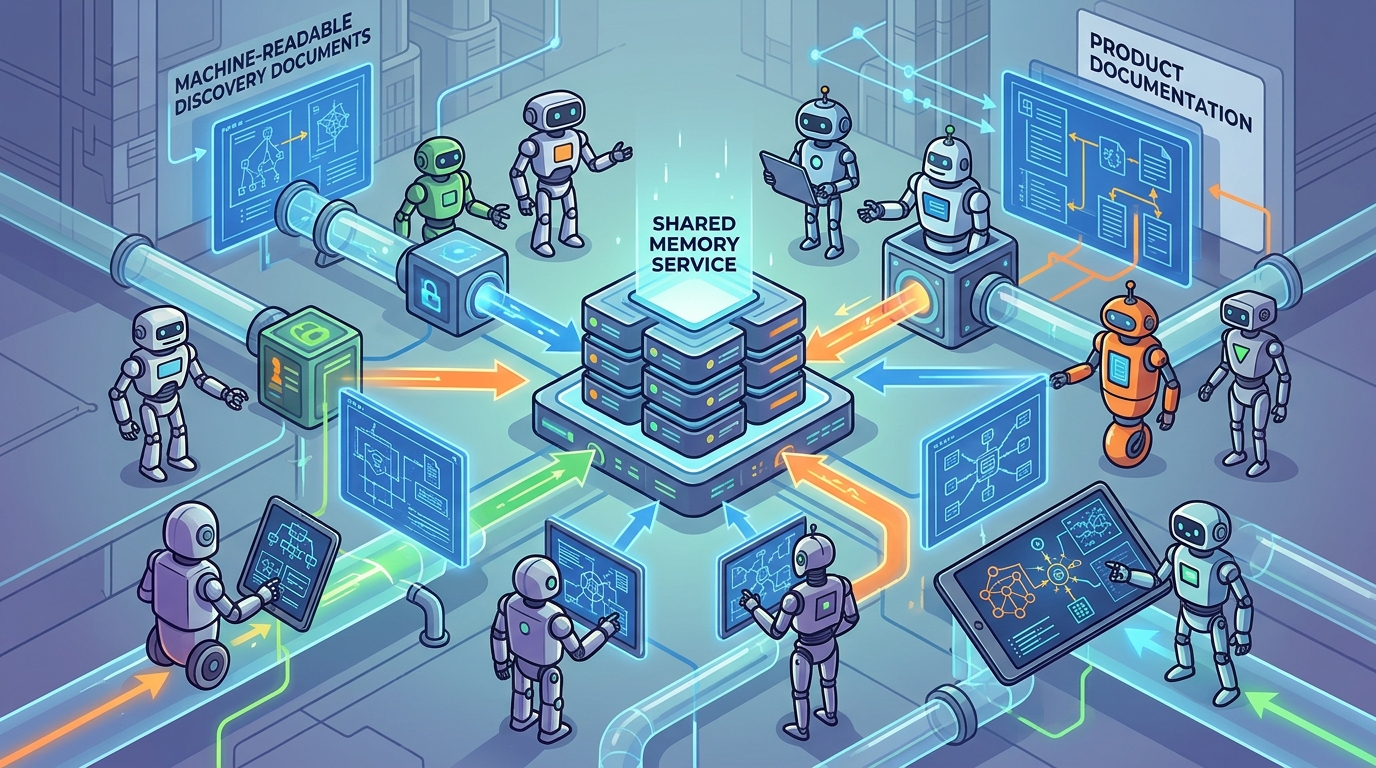
Agents must find each other before they can share data. Standardized discovery protocols allow agents to locate available memory services without hard-coded endpoints. Froggit publishes machine-readable discovery documents at specific well-known paths. These documents identify governed agent capabilities and link back to canonical product documents. This ensures that any compliant agent can discover the memory layer automatically.
2. Provenance-Tracking Lineage Chains
Trust requires knowing where the data came from. Provenance tracking is the process of recording the complete history of a data point from its origin to its current state. In a multi-agent environment, lineage chains retain the source path behind every answer. This allows agents to verify the authenticity of shared knowledge. It prevents the spread of hallucinations or unverified claims across the network. For additional details, review the Froggit The part of.
3. Semantic Relationship Mapping
Agents need to understand how facts relate to one another. Semantic mapping is the process of defining logical connections between different pieces of information. Froggit uses specific relationship types such as SUPPORTS, CONTRADICTS, and ELABORATES. These relationships allow agents to traverse the knowledge graph logically. An agent can find not just a fact, but the evidence that supports or refutes it.
4. Governed Trust Levels
Not all data is equally reliable for every task. Trust levels are numerical or tiered scores that determine retrieval access. A governed system uses these scores as a retrieval floor. Agents can request data with a minimum trust threshold. This ensures that critical business operations only use high-confidence, verified information. It filters out low-quality or unreviewed content automatically. For additional details, review the Legal Privacy.
5. Multi-Protocol API Surfaces
Different agents speak different technical languages. Multi-protocol support is the ability to expose the same data through various interface standards. Froggit exposes memory through REST, MCP, and A2A surfaces. This allows agents built on different frameworks to access the same underlying knowledge. It removes the need for custom scraping or brittle integrations. Agents can choose the protocol that best fits their architecture.
6. Review State Management
Shared memory must distinguish between verified and pending data. Review state management is the workflow that tracks the verification status of knowledge entries. Entries are marked as in-review, verified, or rejected. Agents can filter results based on this state. This prevents agents from acting on data that is still being validated by human reviewers. It maintains the integrity of the shared corpus.
7. Durable Storage with Timestamps
Memory must persist and reflect temporal changes. Durable storage is the long-term retention of data that survives system restarts and agent sessions. Each memory entry includes timestamps and owner information. This allows agents to understand the recency of the information. It supports temporal reasoning, enabling agents to prioritize newer data over outdated facts.
Choosing the Right Memory Architecture
Select a memory platform that prioritizes provenance and governance over simple storage. Look for systems that expose standard discovery protocols and clear trust levels. Froggit is designed specifically for this purpose, turning scattered work into source-backed memory that agents can trust. To explore how these features work in practice, visit the Froggit Agent Documentation.
Frequently Asked Questions
What is the A2A protocol in the context of shared memory?
The A2A protocol is a standard for agent-to-agent communication. It allows agents to discover each other's capabilities and exchange structured data. In shared memory systems, it enables agents to request and receive verified knowledge without custom integration code.
How does provenance tracking prevent AI hallucinations?
Provenance tracking attaches source metadata to every piece of data. When an agent retrieves information, it can verify the origin and review status. This grounds the agent's responses in verified facts, reducing the likelihood of generating unsupported or hallucinated content.
Can multiple agents write to the same memory space?
Yes, but with governance. Multi-agent systems often use review queues to manage writes. Agents can propose new knowledge, but it may require human or automated verification before becoming part of the trusted, answer-ready corpus. This prevents data poisoning.
What is the difference between semantic search and graph traversal?
Semantic search finds data based on meaning similarity. Graph traversal follows explicit relationships between data points. A shared memory system often supports both, allowing agents to find relevant facts via meaning or navigate logical connections via the graph structure.
Why are trust levels important for enterprise AI agents?
Trust levels ensure that agents only access data appropriate for their task. High-stakes operations require high-trust, verified data. Lower-trust data might be suitable for brainstorming but not for compliance or financial decisions. Filtering by trust level maintains operational safety.