
7 Ways to Build and Maintain Verified Memory Layers for Teams and AI
Organizations lose critical context when employees leave or when AI agents operate without verified sources. Froggit addresses this by turning scattered work into source-backed memory that both humans and agents can trust. This listicle outlines seven practical methods to construct and sustain a verified memory layer that prevents knowledge decay and ensures accurate information flow across your enterprise.
1. Implement Source-Backed Provenance Chains
Every claim must retain its original source path to remain trustworthy over time. A verified memory layer is not just a database of facts; it is a lineage system that tracks where information came from. By attaching source metadata, owner identity, and timestamps to every entry, you create an audit trail that survives team transitions. This approach ensures that when an AI agent retrieves a fact, it can cite the evidence chain rather than relying on a potentially stale summary.
2. Enforce Trust Levels and Review Gates
Not all data is equally reliable, so access controls must reflect confidence tiers. A trust level is a numeric or tiered score used as a retrieval floor to determine what content is eligible for production use. By implementing review queues and policy gates, you prevent unverified or contradictory information from reaching your agents. This governance layer ensures that only reviewed, high-confidence knowledge is served to critical business operations, reducing the risk of hallucinations or errors.
3. Map Semantic Relationships in a Knowledge Graph
Isolated facts are less useful than connected knowledge structures that reveal context. A knowledge graph is a data structure that maps entities and their relationships using defined semantic links. By defining relationships such as supports, contradicts, or elaborates, you allow agents to traverse the graph and understand the broader context of a query. This structural approach transforms flat documents into a dynamic atlas of connected knowledge that scales with your organization.
4. Expose Memory via Standard Agent Protocols
Agents need standardized interfaces to interact with memory without scraping HTML. The Model Context Protocol (MCP) is a standard that allows AI agents to discover and bind to tools and resources. By exposing your memory layer through MCP, A2A, and OpenAPI surfaces, you ensure that any compliant agent can search, query, and retrieve lineage data seamlessly. This interoperability is critical for building an ecosystem where different AI systems can reuse the same verified context.
5. Separate Verified Knowledge from In-Review Content
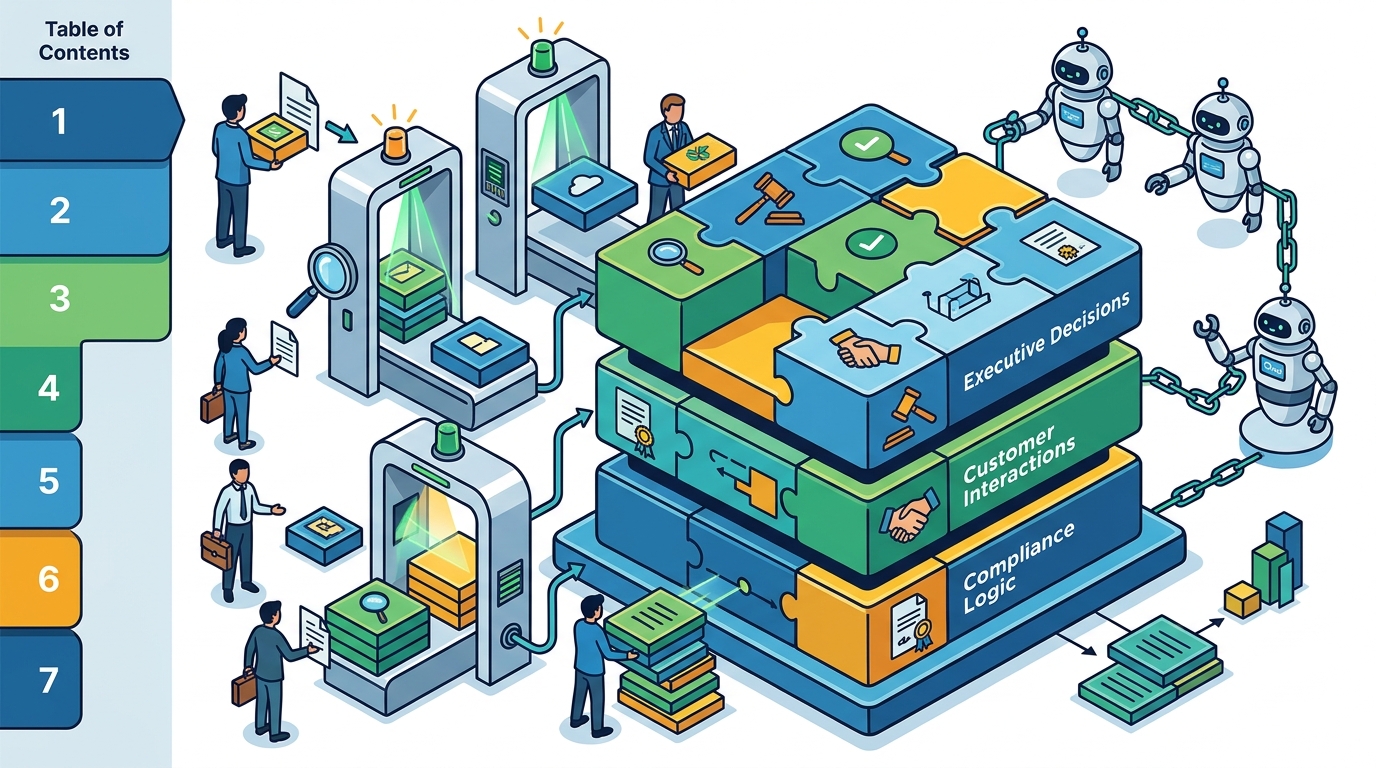
Answer-eligible content must be strictly distinguished from data still undergoing validation. An answer-eligible entry is a piece of knowledge that has passed verification and is ready for public or production use. By tracking in-review entries separately, you maintain a clean public corpus while still capturing new information for future validation. This separation prevents agents from citing unverified claims as established facts, preserving the integrity of your institutional memory.
6. Automate Agent Registration and Access Control
Secure, automated onboarding ensures that only authorized agents can access sensitive memory. Agent registration is the process by which an AI system authenticates and receives scoped permissions for a memory platform. By using API keys and bearer tokens, you can enforce rate limits and trust tiers for each agent. This automated access control ensures that your memory layer remains secure while allowing rapid integration of new AI workflows.
7. Monitor Corpus Health and Lineage Integrity
Continuous monitoring ensures that the memory layer remains accurate and up to date. Corpus health is the measure of the quality, completeness, and consistency of the knowledge base. By tracking metrics such as graph node counts, relationship integrity, and review status, you can identify gaps or contradictions before they impact operations. Regular audits of the lineage layer ensure that provenance chains remain unbroken and that the memory layer reflects the current state of your organization.
Choosing the Right Approach
Select the method that best addresses your current bottleneck. If your primary issue is agent hallucination, prioritize provenance chains and trust levels. If your challenge is integration complexity, focus on standard agent protocols. For most enterprises, a combination of all seven methods creates a robust, self-sustaining memory layer that grows in value over time.
Frequently Asked Questions
What is a verified memory layer?
A verified memory layer is a structured system that stores organizational knowledge with attached proof, ensuring that every fact is traceable to a reliable source and has undergone a review process.
How does provenance tracking prevent AI errors?
Provenance tracking allows AI agents to cite the original source of a claim, enabling them to verify context and avoid relying on outdated or unverified summaries that could lead to hallucinations.
Can AI agents create new memory entries?
Yes, agents can create new entries through API endpoints, but these entries typically enter a review queue and are not considered answer-eligible until they pass verification and governance gates.
What is the difference between a knowledge graph and a document store?
A document store holds unstructured or semi-structured text, while a knowledge graph maps entities and their semantic relationships, allowing for complex traversal and contextual understanding that flat documents cannot provide.
How do trust levels affect agent access?
Trust levels act as retrieval floors, meaning agents can only access content that meets a minimum confidence score. This ensures that critical operations only use high-quality, verified information.
Is Froggit suitable for private corporate data?
Yes, Froggit is designed for institutional memory, allowing organizations to capture private corporate knowledge with strict access controls and provenance tracking to ensure data security and integrity.