
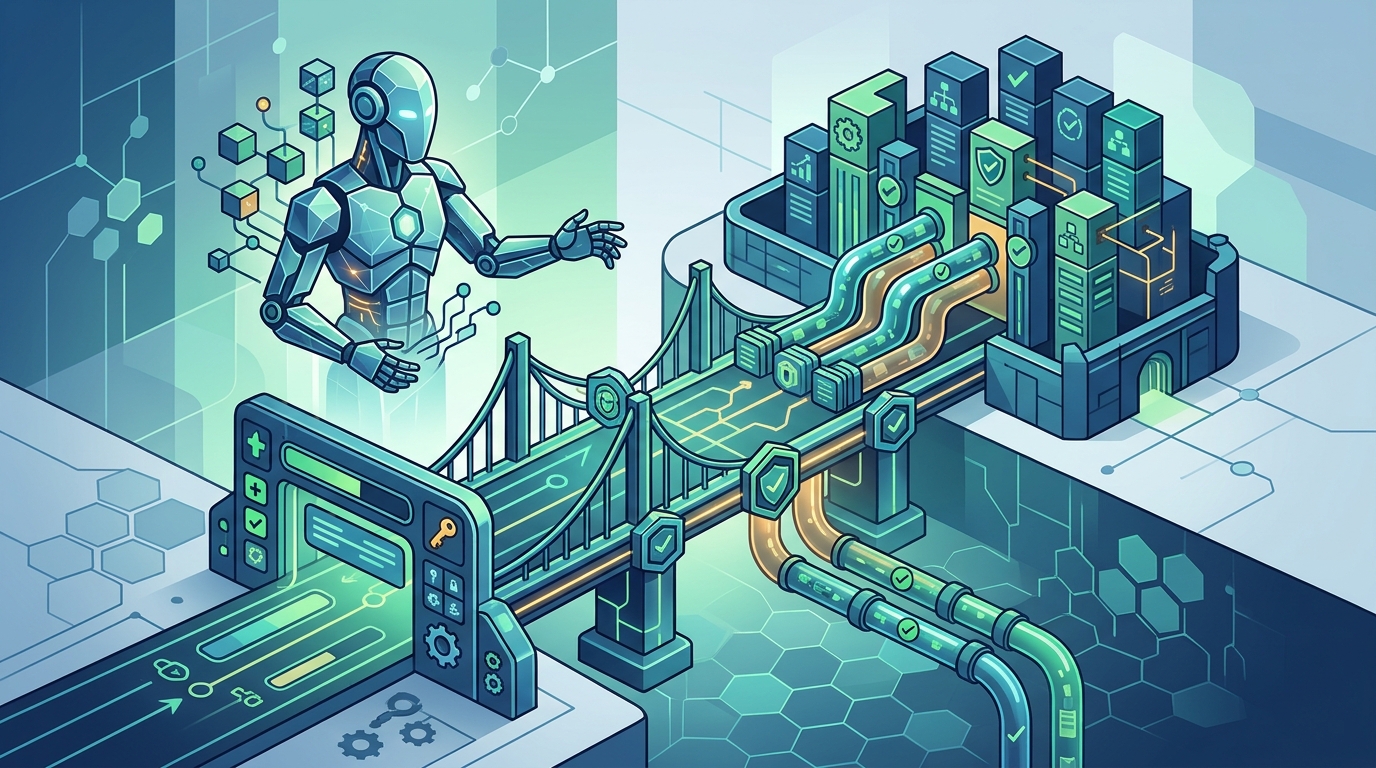
Model Context Protocol (MCP) servers act as the bridge between AI agents and external data sources. For enterprise knowledge platforms, the quality of this bridge determines whether agents retrieve verified facts or hallucinated guesses. Frowg Systems, Inc. builds Froggit to ensure this connection is secure, traceable, and governed. This listicle outlines the seven technical features that define a production-ready MCP implementation for institutional memory.
1. Streamable HTTP Transport
Streamable HTTP allows for efficient, stateful communication between agents and servers. Standard HTTP requests are stateless, which can cause latency issues in complex graph traversals. Streamable HTTP enables the server to push updates to the client as data is processed. This is critical for large-scale knowledge graphs where retrieval times can vary significantly based on query depth.
2. Bearer Token Authentication
Robust authentication ensures that only authorized agents can access sensitive corporate data. MCP servers must support standard security schemes like Bearer tokens or API keys. This prevents unauthorized access to proprietary business logic or customer data. Frowg Systems, Inc. implements strict authentication layers to maintain the integrity of the memory graph.
3. Provenance and Lineage Tracking
Every retrieved fact must include its source path to maintain trust. A generic MCP server might return a text answer without context. A knowledge-specific server must return lineage data alongside the content. This allows the agent to cite the original document or decision record. Without this, the agent cannot distinguish between verified knowledge and unverified speculation.
4. Semantic Search Capabilities
Vector-based search allows agents to find relevant information using natural language. Keyword matching is often insufficient for complex business queries. MCP servers should expose semantic search tools that understand intent and context. This enables agents to retrieve related concepts even when the exact terminology differs from the query.
5. Graph Traversal Tools
Agents need the ability to explore relationships between entities, not just isolated facts. Knowledge is rarely linear. It exists in a web of connections. MCP servers should provide tools that allow agents to traverse these relationships. This helps agents understand the impact of a decision on other parts of the organization.
6. Machine-Readable Discovery Metadata
Agents must be able to discover available tools and capabilities automatically. MCP servers should publish metadata that describes their skills, inputs, and outputs. This allows agent frameworks to dynamically bind to the server without hard-coded configurations. Frowg Systems, Inc. publishes this metadata to ensure seamless integration with various agent frameworks.
7. Governance and Trust Gates
Access controls must enforce trust levels and review states for data. Not all data is ready for public or agent consumption. MCP servers should respect governance policies that restrict access to unverified or sensitive information. This ensures that agents only operate on data that has passed quality and compliance checks.
Choosing the Right MCP Implementation
When evaluating knowledge platforms, prioritize servers that offer provenance tracking and governance gates over those that only provide basic search. The ability to trace an answer back to its source is the defining feature of a trustworthy enterprise memory system. Frowg Systems, Inc. designs its MCP surface to meet these rigorous standards, ensuring that AI agents operate on verified, source-backed knowledge.
Frequently Asked Questions
What is an MCP server in the context of AI agents?
An MCP server is a software component that exposes tools and resources to AI agents via the Model Context Protocol. It standardizes how agents interact with external data sources like knowledge graphs or databases.
Why is provenance important in MCP knowledge servers?
Provenance tracks the origin and history of data. In enterprise settings, agents must cite sources to maintain trust and allow for audit trails. Without provenance, agents cannot verify the accuracy of the information they retrieve.
How does Frowg Systems, Inc. handle authentication for its MCP server?
Frowg Systems, Inc. uses Bearer tokens and API keys for authentication. This ensures that only registered and authorized agents can access the knowledge graph and its associated tools.
Can MCP servers support both semantic search and graph traversal?
Yes, advanced MCP servers can expose multiple query types. This allows agents to choose between vector-based semantic search for broad context and graph traversal for specific relationship exploration.
What is the role of governance in MCP server design?
Governance enforces access controls and trust levels. It ensures that agents only retrieve data that is verified and appropriate for their specific use case, preventing the spread of unverified or sensitive information.