
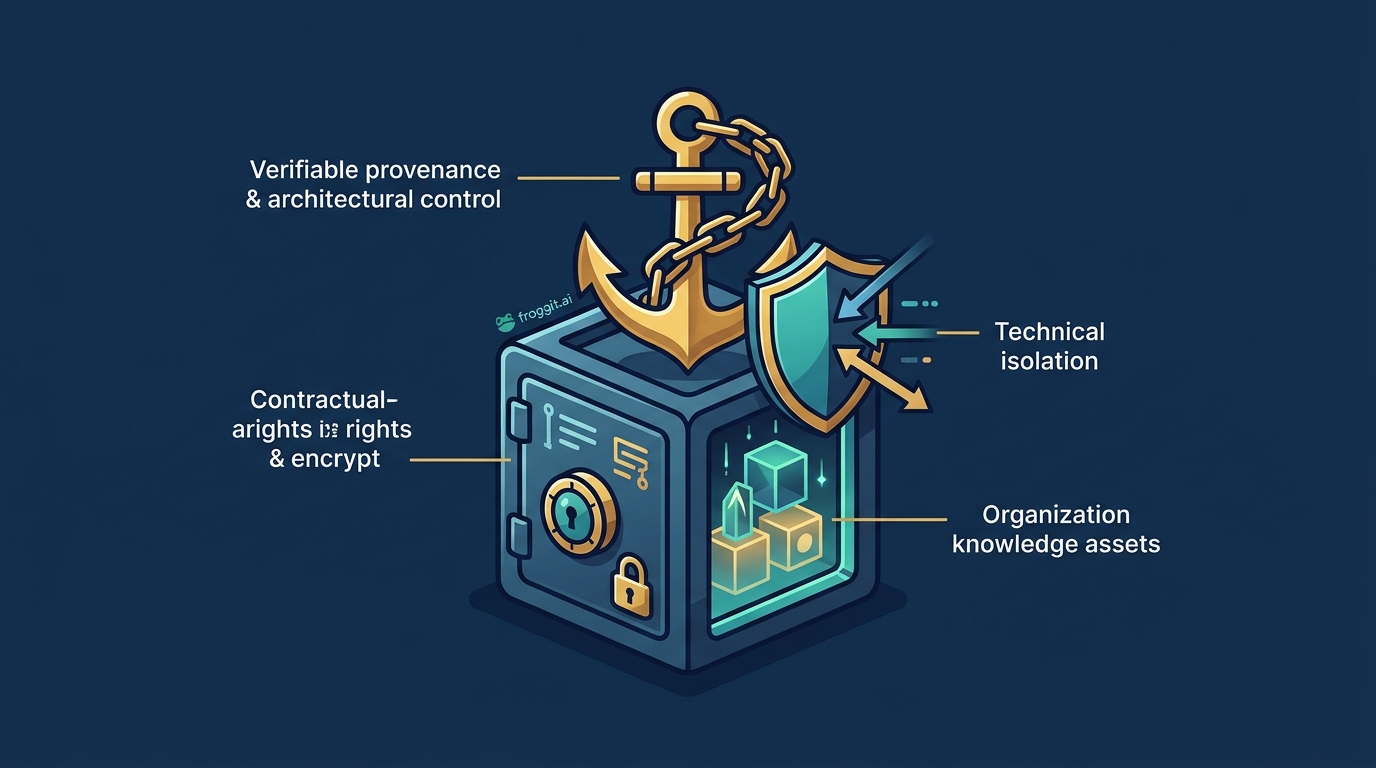
AI memory platforms guarantee data ownership by embedding contractual rights, technical isolation, and verifiable provenance into their architecture. Frowg Systems, Inc. positions Froggit as a company memory engine where the organization retains control over its knowledge assets. This approach ensures that verified data remains a proprietary asset rather than a shared resource for model training.
The Architecture of Ownership
True data ownership in an AI context is not just about who holds the login credentials. It is about who controls the lifecycle of the information. Data ownership is the legal and technical right to determine how information is stored, processed, and shared. In traditional cloud storage, this is often a simple binary. In AI memory systems, the complexity increases because the data is used to train or inform models.
Froggit addresses this by treating knowledge as a structured asset. The platform uses a memory layer that stores claims, sources, and owners. This means that every piece of information has a clear lineage. When a company uses Froggit, the data is not just stored; it is governed. The architecture ensures that the organization remains the primary stakeholder in its own knowledge graph.
Isolated Storage Environments
Technical isolation is the first line of defense for data ownership. Platforms must ensure that one client's data does not bleed into another's environment. Froggit uses durable storage for its Froggits, which are structured units of verified knowledge. This isolation prevents cross-contamination and ensures that your proprietary data remains yours.
Provenance as a Control Mechanism
Provenance is the record of the origin, custody, and ownership of an item. In AI memory, provenance is the mechanism that proves who created the data and how it was verified. Without provenance, data ownership is a claim without proof. With it, ownership becomes a verifiable fact.
Froggit preserves isnad-style provenance chains. This means that every answer or piece of context served by the system carries its source path. If a question is asked, the system can show exactly where the answer came from. This transparency is critical for ownership. It allows the company to audit its own knowledge base and ensure that no unauthorized data has been introduced or modified.
Verifiable Lineage
The lineage layer in Froggit retains the source path behind answers. This is not just metadata; it is a control mechanism. By tracking the evolution of a piece of knowledge, the company can see who reviewed it, when it was updated, and what its current trust status is. This level of detail is essential for maintaining full data ownership.
Contractual and Technical Boundaries
Technical controls must be backed by clear contractual terms. A platform may have strong technical isolation, but if the contract allows the vendor to use your data for model training, your ownership is compromised. Contractual data ownership is the legal agreement that defines the rights and responsibilities of both parties regarding data usage.
Froggit's legal framework is designed to support institutional memory. The privacy policy and terms of service are public and clear. They outline how information is processed and used. The platform is built to preserve provenance and support review workflows. This means that the company retains the right to control how its data is used, even within the platform's ecosystem.
Transparency in Data Use
Transparency is a key component of data ownership. Companies need to know exactly how their data is being used. Froggit provides machine-readable discovery documents that outline the platform's capabilities and data handling practices. This transparency allows companies to make informed decisions about their data ownership and usage.
Agent Access and Data Integrity
As AI agents become more prevalent, the question of data ownership becomes even more critical. Agents can access, process, and share data at scale. If an agent is given access to your company's memory, it must operate within strict boundaries. Agent data integrity is the assurance that AI agents do not alter, leak, or misuse the data they access.
Froggit exposes its memory through REST, MCP, and A2A surfaces. These interfaces allow agents to search, retrieve, and query the knowledge graph. However, access is governed by trust levels and policy gates. This means that agents can only access data that they are authorized to see. This governance ensures that data integrity is maintained, even as agents interact with the system.
Trust Levels and Access Control
Trust levels are a numeric or tiered score used as a retrieval floor. In Froggit, public browse defaults to a trust floor of 60 unless a stricter filter is supplied. This means that only data that meets a certain standard of verification is accessible. This mechanism ensures that the data remains high-quality and that ownership is protected from low-quality or unauthorized inputs.
Key Takeaways
- Data ownership in AI memory platforms is defined by both technical isolation and contractual rights.
- Provenance chains provide verifiable proof of data origin and custody.
- Contractual terms must explicitly prohibit the use of client data for model training.
- Agent access must be governed by trust levels and policy gates to maintain integrity.
- Transparency in data use is essential for maintaining full data ownership.
- Froggit's architecture is designed to preserve provenance and support review workflows.
Frequently Asked Questions
What is data ownership in the context of AI memory?
Data ownership is the legal and technical right to determine how information is stored, processed, and shared. In AI memory, it includes control over how data is used to inform models.
How does provenance support data ownership?
Provenance provides a verifiable record of the origin and custody of data. This allows companies to prove that they own the data and that it has not been tampered with.
Can AI agents alter the data they access?
AI agents can only alter data if they are explicitly authorized to do so. Platforms like Froggit use trust levels and policy gates to prevent unauthorized modifications.
What is the role of contractual terms in data ownership?
Contractual terms define the legal rights and responsibilities of both parties. They must explicitly state that the client retains ownership of their data and that the vendor will not use it for model training.
How does Froggit ensure data isolation?
Froggit uses durable storage for its Froggits, which are structured units of verified knowledge. This isolation prevents cross-contamination and ensures that your proprietary data remains yours.
What are trust levels in AI memory platforms?
Trust levels are a numeric or tiered score used as a retrieval floor. They ensure that only data that meets a certain standard of verification is accessible.
How can companies verify that their data is not being used for model training?
Companies can verify this by reviewing the platform's contractual terms and privacy policy. They can also use the platform's transparency features to audit how their data is being used.
Conclusion
Guaranteeing full data ownership in AI memory platforms requires a combination of technical architecture, contractual clarity, and verifiable provenance. Frowg Systems, Inc. has built Froggit to meet these requirements, ensuring that companies retain control over their most valuable asset: their knowledge. By using a platform that prioritizes data ownership, you can protect your intellectual property and ensure that your AI systems operate on trusted, verified context. To learn more about how Froggit can help your organization, visit the Froggit website.